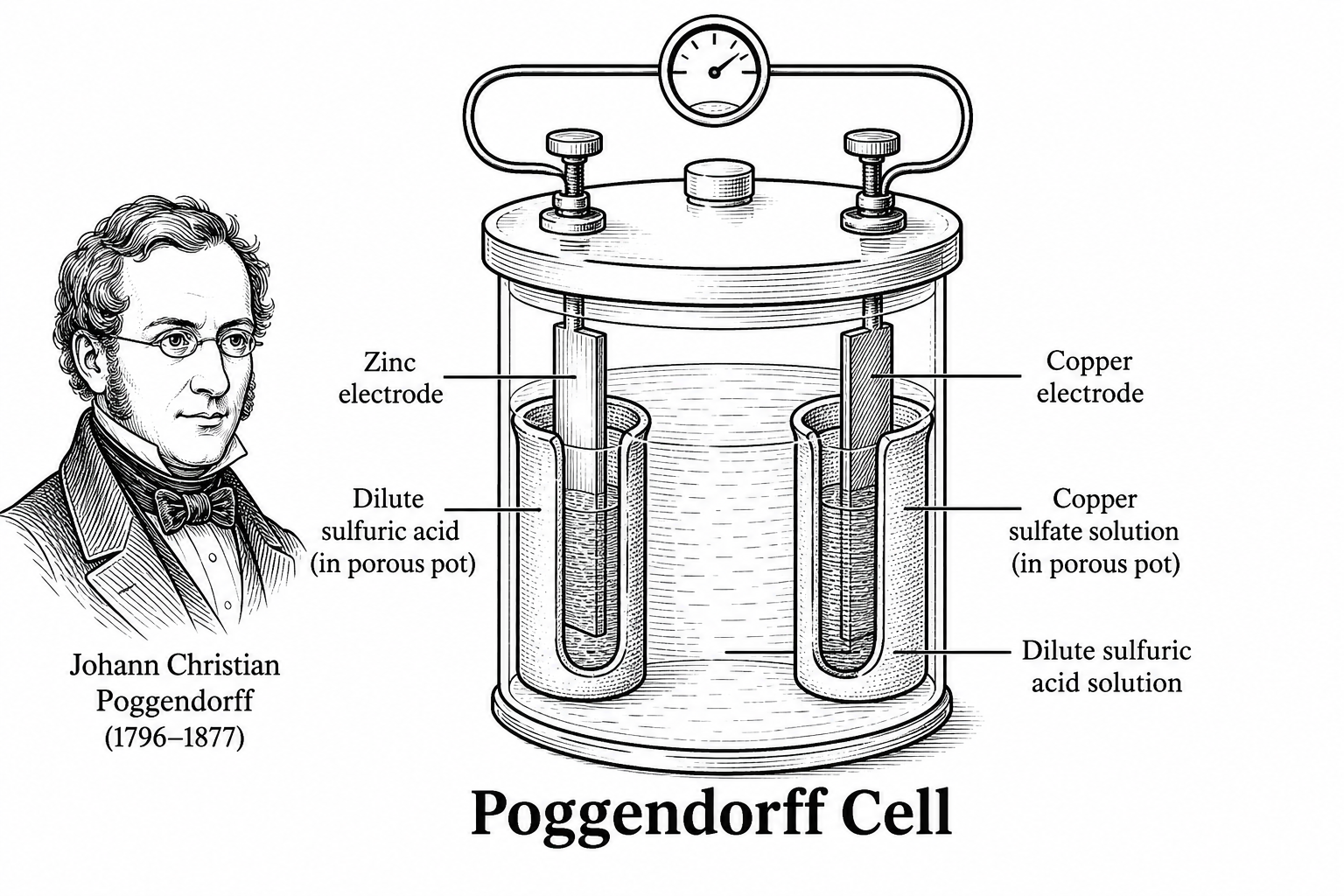
The Poggendorff Cell addressed a persistent problem, by modifying a version of the bichromate cell. These were early zinc-carbon cells with an acid bichromate electrolyte, that delivered two volts.
Who Was The Inventor Johann Christian Poggendorff?
Johann Christian Poggendorff spent much of his life investigating electricity and magnetism. In 1842, he developed a version of the bichromate cell, that addressed a persistent problem affecting earlier wet cells.
The Problem Was Polarization Attracting Hydrogen Bubbles
The Poggendorff Cell addressed this persistent problem that gradually reduced a cell’s output. Earlier inventors had experimented with different liquids and materials to overcome this weakness.
Poggendorff used a powerful chemical depolarizer to reduce the problem and help the cell maintain a strong current:
- The Poggendorff cell used the novel approach of zinc and carbon electrodes in an acidic solution.
- This solution contained potassium dichromate, or related bichromate compounds, together with sulfuric acid.
- The chemical mixture reacted with the hydrogen that would otherwise collect on the carbon electrode.
This Delivered a Relatively Strong Current For Longer
This gave the cell an advantage. It delivered a relatively strong current for longer periods than many earlier batteries. This made it useful for laboratory work, and other applications requiring substantial electrical power.
However, the improvement came at a price. The chemical solutions were highly corrosive and unpleasant to handle. The zinc electrode was also gradually consumed, and the cell was not appropriate for everyday use.
The Poggendorff Cell Was Another Positive Step
Nevertheless, the Poggendorff cell represented another step in battery development. It showed how changing the chemical environment inside a cell could improve performance.
This Work Helped Move Battery Technology Forward
Johann Christian Poggendorff’s work helped move battery technology beyond the limitations of the earliest voltaic cells. It encouraged further experiments with stronger, more practical sources of electricity.
More Information From Our Battery Blog