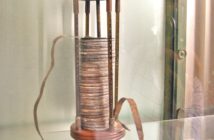
Alessandro Volta made the world’s first battery in 1791. We don’t know why he piled alternating copper and zinc disks atop each other. Or insertted brine-soaked cardboard or cloth between them. But we know the two metals combined with the strong salt-water solution to produce a stable and continuous electric current. However, Volta did not understand how the power from zinc and copper worked. Moreover, the current was not sufficiently strong to cause a spark.
Where Volta Thought Power from Zinc and Copper Came
Alessandro Volta thought the electrochemical reaction producing the electricity came from the copper and zinc disks touching. This theory of contact electrification, or electrostatic charge imbalance, later gave way to modern understanding of how electrons pass through electrolytes. Nonetheless, Volta’s discovery of the power of zinc and copper gave us our first working battery. Here’s a cool video proving the acidic brine solution released the power from zinc and copper in 1791. We apologize for the lack of soundtrack but we believe it illustrates the point.
How We Built on Volta’s Revolutionary Discovery
Others took up on the idea, after Volta reported his voltaic pile to the London Royal Society in 1800, In 1838, John Dancer immersed a zinc anode in zinc-sulfate solution in a porous clay pot. This pot was in turn inside a copper container, which functioned as the cathode. In this way, the ions could pass through an insulating barrier. Moreover this resolved Volta’s problem of the cardboard, or cloth leaking electrode from an open pile.
A chain of exciting inventions followed the discovery of the power from zinc and copper. This lead to the Gaston Planté lead–acid battery invention of 1859. There have been many advances since then, including nickel, cadmium and lithium-ion cells. All follow the same basic principles, but to this day lead-acid batteries still play a leading role in our lives.
Here’s a neat video showing how to make an electric cell using diluted sulfuric acid and copper and zinc plates. Please DO NOT attempt this without an adult present. Because hydrochloric acid can burn our skin, and harm our lungs.
Related
Alessandro Volta: Father of Modern Battery
Gaston Planté’s Lead-Acid Cell Battery
Preview Image: Early Lead-Acid Batteries
Video Share Links
Salt Test: https://youtu.be/6U9f8Q3Y_SY
Acid Zinc and Cooper Cell Experiment: https://youtu.be/3wLJLm0QLpg