Dalhousie University scientists in Nova Scotia, Canada developed a single crystal EV battery electrode, that cycled 20,000 times over six years. Interesting Engineering ran the numbers, and equated this to driving an EV for five million miles. We append a link to the Dalhuosie University research at the end of this post. But first, what exactly is a single crystal electrode?
Single Crystal Electrodes for EV Batteries
A single crystal electrode comprises atoms arranged in a perfectly ordered continuous pattern, according to a Google AI overview. This makes the crystal an ideal material for studying electro-catalytic surface absorption, and reaction kinetics.
The drive is on to develop electric vehicle lithium-ion batteries that retain 80% of their capacity after eight year’s use. The Dalhousie scientists explored an alternative possibility by following a new angle.
Their new approach centered on a single crystal EV battery electrode, that had been cycling non-stop in their laboratory for more than six years. When they reviewed the data, they discovered the battery had charged and discharged over 20,000 times, before reaching the 80% capacity cut-off point.
The battery in question was a commercially manufactured polycrystalline NMC622 pouch cell. This meant it used lithium nickel manganese cobalt chemistry, instead of the traditional lithium-ion alternative.
Lithium Nickel Manganese Cobalt Versus Lithium-Ion
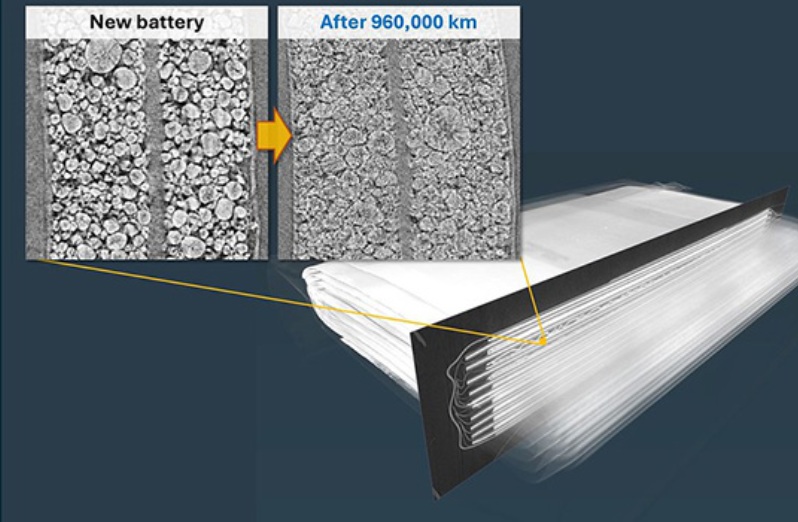
The researchers were keen to understand how their NMC battery managed 20,000 cycles, compared to lithium-ion’s 2,400. They expected, and they found different levels of damage and fatigue, when they looked inside the two batteries:
- The traditional lithium-ion battery displayed extensive microscopic cracking in the electrode material.
- The Dalhousie team suspected that this degradation was the result of repeated charging and discharging.
- By comparison, the single crystal electrode battery showed almost no signs of mechanical stress.
This finding suggests that single crystal EV battery electrodes could be ideal candidates for electric vehicles, and energy storage in future.
More Information
Single Crystal Cluster Materials For Cathodes
Nanocrystals: The Source Of Degradation In Lithium-Ion Batteries
Preview Image: Effects of Mechanical Degradation