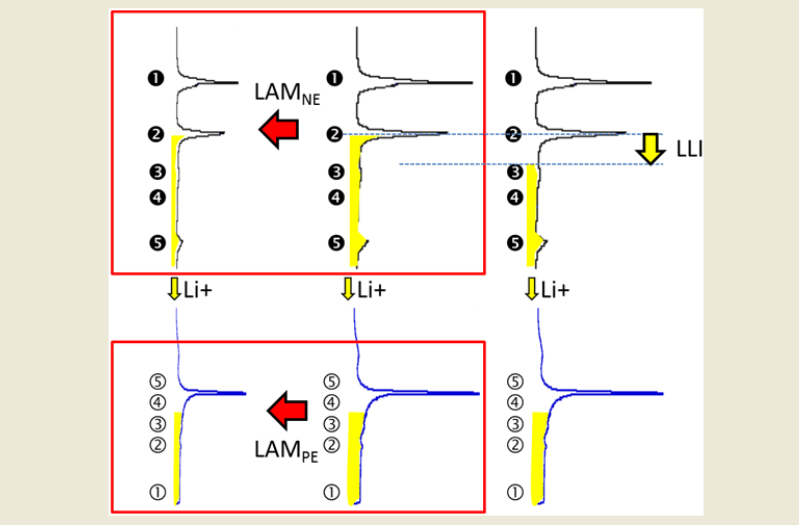
The degradation drivers in lithium-ion battery capacity reduction, are loss of active material, and loss of lithium available for cycling. Today we delve deeper into the characteristics and mechanisms behind these events, with particular reference to mild mechanical battery deformation.
Mild Pressure and Degradation Drivers in Lithium-Ion Cells
We came across a report in the Journal of Energy Storage, for the period ending February 1, 2025. This recorded how a team from Lanzhou University of Technology, China investigated the effect of mild mechanical pressure on lithium-ion batteries.
Their subject batteries were several commercial pouch-type lithium-iron-phosphate cells, at different initial states of charge (SOC). Their main findings make interesting reading, namely:
- Mild mechanical deformation notably affected the internal resistance and capacity of lithium-ion pouch batteries.
- But as the initial state of charge decreased, both internal resistance and capacity degradation became more intense.
As the research report in the Journal of Energy Storage explains, the severest capacity degradation occurred at 30% state of charge. Whereas at between 80% and 100% SOC, resistance increased, and the degradation drivers in lithium-ion batteries became less potent.
Scanning electron microscopy-imaging revealed what was happening inside the lithium-iron-phosphate pouch cells, during periods of light mechanical compression. The team noted structural and morphological changes in the electrodes, including graphite particles breaking away.
But they also saw reduced / stretched pore-size and decreased porosity at the separator, and concluded that the loss of active material increased internal resistance, and capacity degradation.
Why We Shared The Findings of This Particular Study
Lithium-ion batteries play an essential role in the migration towards energy storage grids, electric vehicles, and portable electronic devices. Lithium-ion batteries deliver great storage capacity, but can behave unpredictably when damaged.
This small, but important study reveals how lithium-iron-phosphate batteries behave following slight compression. Initial minor damage could lead to catastrophic failure later. The team from Lanzhou University of Technology may have witnessed the first phase in this critical chain of events.
More Information
Lithium-Sulfur Battery Capacity Innovation
Lead-Acid Battery Capacity Really Matters