

Researchers at University of Queensland, Australia have been busy ‘down under’. They have now published an open source report on March 23, 2022 in Nature Communications. In it, they claim to have developed technology to double lithium battery life. Could future batteries keep going and going, a press release from their Uni asks. Now that’s a noble ambition for sure!
Nano Technology To Double Lithium Battery Life
The team worked under guidance from Professor Lianzhou Wang at University of Queensland School of Chemical Engineering. But they also collaborated with colleagues from Australian Institute for Bioengineering and Nanotechnology to promote a balanced skill set.
Their combined brain power produced a lithium-ion battery which remains stable for more than 1,000 charge/discharge cycles. “Our process will therefore increase the life-span of batteries in many things. That’s from smart phones and laptops, to power tools and electric vehicles,” Professor Wang believes.
“This is because we’ve designed a uniquely-grown atomic-thin functional layer on the surface of a high-voltage cathode,” he continues. “And the cathode is the source of lithium ions and a critical aspect that limits the cycle life in a battery.” But how exactly does this work we wondered?
Eliminating Corrosion is Key to the New Battery
Professor Lianzhou Wang developed his technology to double lithium battery life on a simple premise. That first principle is “corrosion in one form or another is the reason that batteries degrade over time” as he puts it.
Therefore, his novel approach coats the cathode with a “minimal protective coating at a scalable process”. And this paves the way for the “deployment of abundant high-voltage materials for next generation high energy batteries.”
He is moreover confident his technique will have applications in consumer electronics, electric vehicles and the energy storage sector. We understand the new method may also have potential to stabilize other cathode materials that degrade with recycling too.
Breaking News
Utility Scale Battery Performance Strategies
Flow Battery with Simple Organic Electrolyte
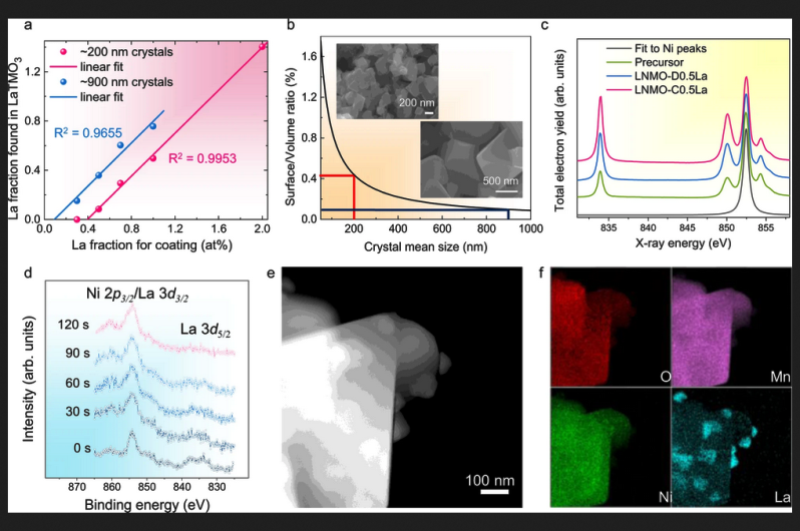
Preview Image: Surface Enrichment of La


