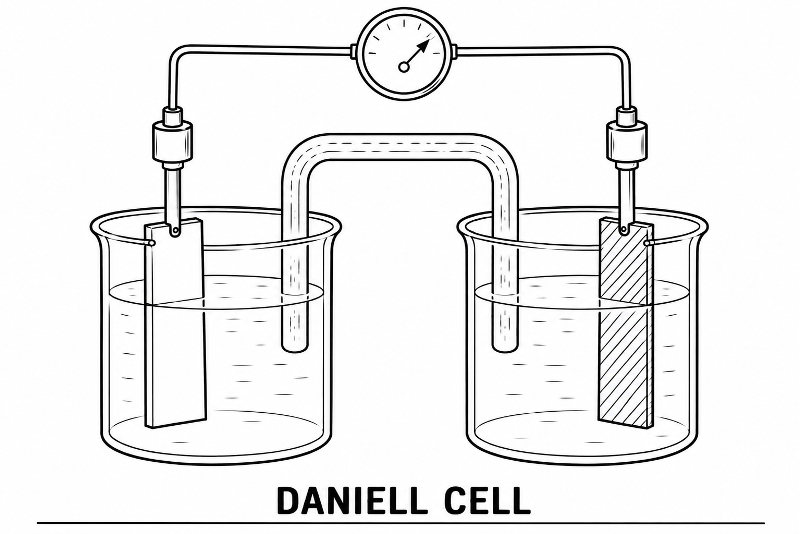
English chemist and meteorologist John Frederic Daniell, invented this cell in 1836. His Daniell Cell was a more reliable source of electricity, and an important step in the evolution of battery chemistry. It overcame one of the biggest problems affecting earlier batteries, which was polarization.
The Voltaic Pile Made Electricity But Generated Hydrogen
The earlier voltaic pile produced electricity through a chemical reaction between different metals and an electrolyte. However, hydrogen gas could collect on the copper surface.
This reduced the cell’s ability to produce a steady current. Scientists needed a battery that could operate for longer periods, without rapidly losing performance.
Daniell’s Solution Was To Separate The Two Chemical Processes
Daniell’s solution was to separate the two chemical processes. His cell used a zinc electrode in a zinc sulfate solution, and a copper electrode in a copper sulfate solution. A porous barrier separated the liquids while still allowing the chemical process to continue.
This arrangement produced a much more stable current. Instead of hydrogen building up on the copper electrode, copper from the solution deposited onto it. This made the Daniell cell a more reliable source compared to Volta’s pile.
The Daniell Cell Arrived At An Important Moment In History
The Daniell cell arrived at an important time in society. Science and industry were indeed advancing rapidly during the nineteenth century. Reliable electricity was increasingly essential for laboratories, telegraph systems and scientific demonstrations.
The electric telegraph, in particular, created a growing demand for cells that could provide a steady current over extended periods.
Daniell Improved Performance By Controlling Chemistry
John Frederic Daniell’s invention showed that battery performance could be improved by carefully controlling the chemistry inside the cell.
His cell was not simply a stronger version of the voltaic pile. It represented a new stage in battery development, where scientists began designing cells around the behaviour of specific chemical reactions.
This Principle Would Influence Many Later Battery Technologies
This principle would influence many later battery technologies, and eventually help shape the chemistry behind rechargeable lead-acid batteries.
More Information From Our Battery Blog