Battery charging will continue to be a critical factor for busy electric vehicle owners. They don’t have time for technical explanations. They just want a simple measure that enables them to compare their options. The C-Rate battery charging factor does away with technical jargon, and provides the information in a form we all understand.
What the C-Rate Battery Charging Factor Tells Us
The C-Rate battery charging factor tells us how many times a battery could fully charge in one hour. So to cite a few examples, a C-Rate of 0.5 tells us it would take 2 hours to fully charge the battery. Whereas, a battery with a C-Rate of C2 would only take 30 minutes.
However, this is not to say that this would necessarily materialize in the real world. The battery charger would have to be able to deliver the energy sufficiently quickly to the battery cathode. For this reason, most battery chargers have a C2 cap, according to Quantum Scape.
We also need to remember that regularly fast-charging a battery reduces its effective lifespan. It is therefore far better to recharge an electric vehicle gently overnight, than to ‘force feed’ it so we can get back on the road again. When a dealer mentions a C-Rate, ask them whether this requires fast-charging.
Questions to Ask About a Battery C-Rate
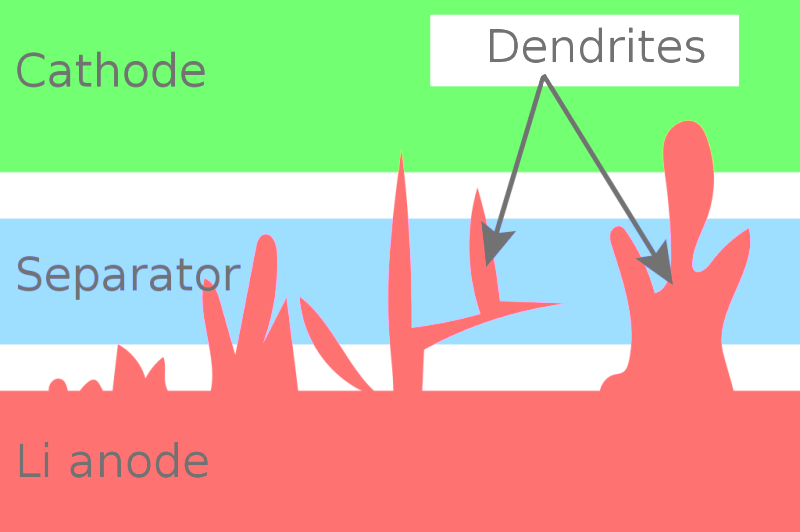
Needle-like dendrite structures can form on the anode surface of lithium batteries, and find their way through the separator where they short-circuit the cathode, and destroy the battery cell.
However, slow charging at a low C-Rate of say 0.2 can help prevent, or shrink the dendrites and extend the life of the battery. Conversely, fast discharging at a C-Rate of 1C or 2C could also retard dendrite development.
It follows that a high C-Rate may look good on paper, but become bad news under some circumstances. Always purchase your batteries from suppliers that you can trust to give you honest advice. Lead-acid batteries do not form dendrites.
More Information
Charging To 80% From 10% In 5 Minutes