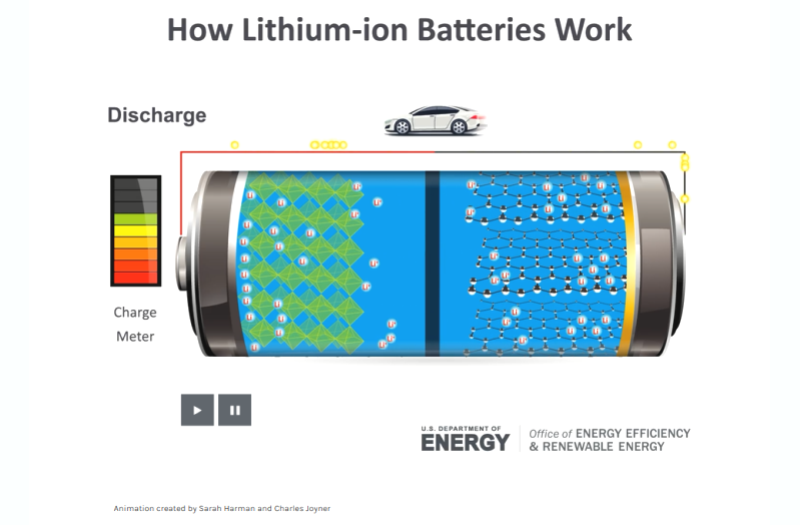
There are different types of lithium-ion batteries on the market, although they all work the same way internally. They store and deliver their power through movement of their electrons and ions.
When lithium-ion batteries charge, these ions move from their cathode to their anode electrodes through an electrolyte. While the electrons simultaneously travel through the external circuit in the opposite direction. Electrons and ions flow back when the battery discharges.
Different Kinds of Lithium-Ion Batteries
Lithium-ion battery cells come in different shapes and sizes depending on how we use them:
- Small, cylindrical cells and flat penny batteries work alone or in sets. They power a vast number of small, hand-held devices.
- Rectangular prismatic lithium-ion cells have greater energy capacity. This makes them suitable for electric vehicles and battery storage farms.
- Flexible pouch cells are lightweight and can have thinner profiles. This makes them popular in laptops, tablets and smartphones.
What’s Inside These L-ion Battery Cells
The external appearance may be different, but all types of lithium-ion battery cells have the same components inside:
- Negative anode electrodes that store the lithium-ions, and are usually graphite. Anode design affects how well the electrons flow through the external circuit.
- Positive cathode electrodes, often containing cobalt, manganese, iron phosphate, or nickel with lithium oxide, affect battery performance, safety and cost.
- Battery electrolyte is the ‘highway’ along which lithium ions travel between the anode and cathode. The material used affects battery performance, safety and cost.
- The separator porous membrane only allows lithium ions to pass through. A separator prevents the anode and cathode from touching, and short-circuiting all their energy instantly.
How Safe are Lithium-Ion Batteries – Can I Be Sure?
Lithium-ion batteries are popular because they pack more power. Therefore, it makes sense to purchase quality batteries able to contain this energy. Responsible manufacturers include battery temperature management systems, and stable separators too.
However, it is up to the consumer to ensure that they don’t damage any of the three types of lithium-ion batteries. They need to take care that they follow the charging instructions, and never leave a lithium-ion battery charging on its own.
More Information
Recharging Lithium-ion Batteries in Apartments