We recently wrote about the various improvements in lead acid battery technology since its invention in 1860. While its versatility, power, and affordability are still unmatched, the lead acid battery is still a little overweight. Really, it’s chubby. Or big-boned… Heavy. Fat. For example, the TLV1272F1 weighs 4.865 lbs (2.207 kg). Some of us use it for exercise, instead of a 5-pound dumbbell, like in this Men’s Health video:
Don’t do this at home. The battery’s terminals and corners can scratch.
Anyway, the TLV1272 is a good looking, powerful battery. It could be the medium-weight champion, probably. But, our capitalist society is following Hollywood’s lead: lighter is better, they say. No room for the natural variety of size and weight.
Like the rest of us, lead acid batteries are trying to fit in, with the help of science. Instead of popping speed-pills Requiem-for-a-Dream-style, our fat friend is recommended to acquire bipolarity. The idea of the bipolar electrodes seems to have first appeared in 1956 (US Patent 2969315). Ideas to apply it to the lead acid battery in order to make it “lightweight” started to be thrown around in 1979 (US Patent 4275130) at CalTech, less than 15 miles away from Hollywood.
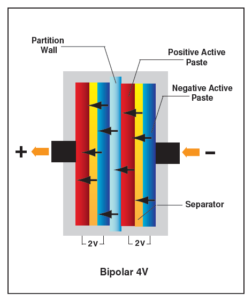
The science, according to the