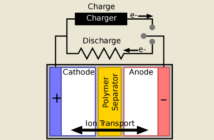
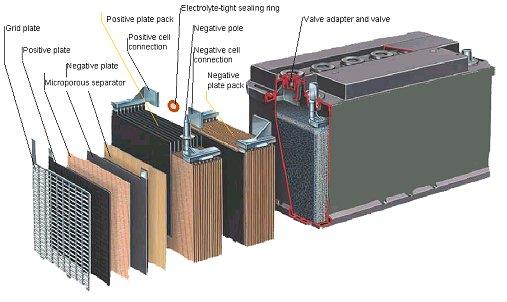
From a previous post we learned about sealed lead acid batteries (SLAB). These batteries are made up of lead acid cells having two lead plates submerged in an electrolyte solution of sulfuric acid and water. Each Lead Acid Cell holds 2 volts, and so we can compute the total voltage of a battery by counting the total number of cells multiplied by two. This is common to those batteries used in cars and motorcycles and may also be applied to those used in PC’s and other electronics.
What is Voltage?
The simplest definition of Voltage refers to the difference in electric potential between the positive and the negative terminals of a battery. The greater the potential difference, the greater the voltage will be.
But voltage isn’t the only factor that affects battery life. We also have to consider the current drawn from the battery and the internal resistance of the battery itself.
Ohm’s Law

To simplify our discussion, we take Ohm’s Law into consideration so,
V=IR ;
where V is the Voltage (Volts), I is the Current (Amperes) and R is the Resistance (Ohms). We can see from the equation that Voltage is the product of the Current multiplied by the Resistance. This means that any change in either the Current and/or the Resistance directly affects the Voltage. The current of the battery remains relatively constant throughout its useful life but the internal resistance of the battery increases with age therefore the voltage the battery delivers decreases until such a time the battery will already be “dead” and have to be replaced.
A good example of this is your car’s battery which powers the engine‘s starter. When your battery is new, it can deliver the needed current to turn the engine on via the starter. But as your battery ages, its internal resistance increases thus the current it delivers decreases and you won’t be able to start your car!

Related articles:
Defining volts, watts, amps, ohms