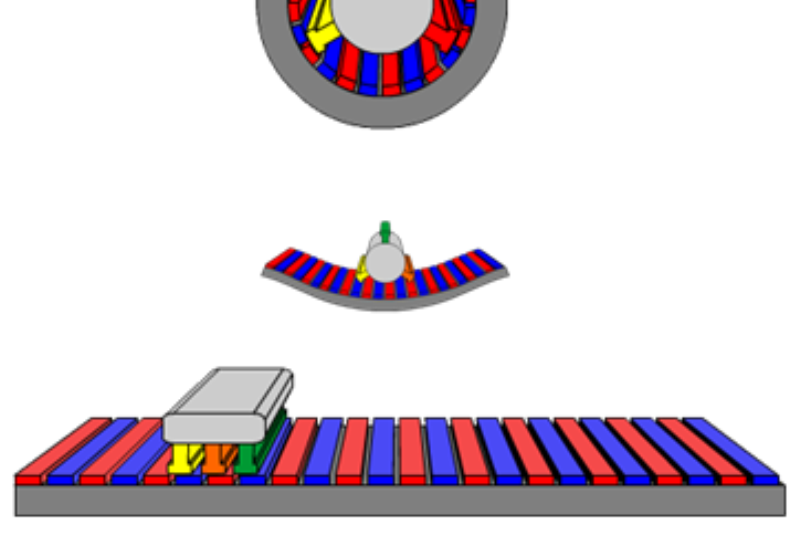
At the end of this article we’ll explain how to make a linear electric motor for a school project. This is going to be a scaled-down simulation of the real thing. But first, we need to explain what linear motors are, and how they power real electric trains.
What Is a Linear Electric Motor?
Most motors operating on electricity cause things to rotate, like electric car wheels for example. However, the motors that we are speaking of here make things move in a straight line:
- In a regular motor, electrical energy creates a magnetic field that turns a shaft.
- In a linear motor, that same idea ‘unrolls’, so the force pushes an object forward.
A linear electric motor achieves this by using electromagnetic induction. When electricity flows through a wire, it creates a magnetic field. If that field interacts with another magnetic field, it can create motion.
By carefully controlling the current, engineers can make objects move smoothly and quickly in one direction. The engineering is quite complicated. Let’s unpack this in a school experiment.
Let’s Make the Motor at Home
That video shows how to place a small cell battery inside a home-made copper coil. But first, you need to attach three suitable-size neodymium magnets at each end.
When the magnets touch the coil of copper wire, electricity flows from the battery through the wire and creates a magnetic field. This field pushes against the battery, causing it to move forward through the coil.
The coil acts like the track, and the battery becomes the moving part of a basic linear motor. In real life, of course, engineers use the same idea in more advanced ways.
Linear electric motors power things like high-speed trains, factory conveyor systems, and automatic doors. Our classroom experiment may be small and simple, but it demonstrates how electricity creates motion through magnetism.
More Information
Prove the Principles of Electromagnetism