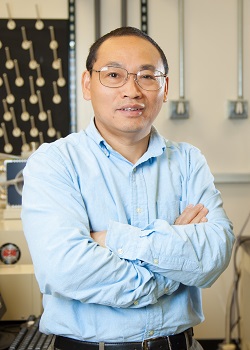
Zhifeng Ren, M.D. Anderson Chair professor of physics
Image taken from uh.edu
The newest thermo-electric material in the last sixty years has recently been discovered by a team of physicists at the University of Houston led by Zhifeng Ren, M.D., Anderson Chair professor of physics at UH. The work was carried out in collaboration with the Massachusetts Institute of Technology and the findings were published in an online paper of which Professor Ren is the lead author and Huaizhou Zhao and Jiehe Sui are primary contributors. The material is currently being referred to as “MgAgSb-based material” as it has not yet been named.
A step up from Bismuth telluride – the traditional thermo-electric material which can only be used at temperatures up to 482 degrees Fahrenheit, this new material performs optimally between room temperature and 573 degrees Fahrenheit. Since waste heat temperatures often range between 392 degrees and 1832 degrees Fahrenheit, Ren and his team continue their work in attempts to further increase the efficiency of the material.
The new material holds remarkable potential for the research and marketing of clean energy. Heat which was being wasted can now be captured and used to make electricity. Thus heat being emitted from power plants and other sources, with this new material, can be used to make electricity.
This achievement represents gradual improvements on years of research. In the 2012 work done by M.J. Kirkham’s team, equal parts of magnesium, silver and antimony were used hoping to achieve the same results. However, this resulted in a material which was a poor conductor with impurities. By modifying the quantities of silver and antimony, mixing the elements separately and modifying the ball milling process, Ren and his team have created a material which has no impurities, smaller grain size and vastly improved thermo-electric properties.