Aluminum-air batteries have been in the news lately because of exciting research. However, many of us have difficulty getting our minds around them. Perhaps this is because we can’t believe they could be that simple in theory. We decided it would be cool to do a DIY aluminum-air battery experiment, to prove they really are that basic.
Requirements for DIY Aluminum-Air Battery Experiment
# Suitable-size glass jug
# Two ounces of table salt
# Half pint drinking water
# Two square foot kitchen foil
# One piece of paper towel
# Handful of steel wool
# Two wires with alligator clips
# Multi meter set to lowest resistance
You also need cook’s permission to help yourself to most of this everyday kitchen stuff.
Now Watch How to Conduct this Cool Experiment
Scientific Principles behind Your DIY Aluminum-Air Battery
Firstly, the salt and water solution is the electrolyte for the DIY aluminum-air battery. Then the scrunched up kitchen foil is the negative anode. Plus the paper towel is the separator. Finally, the steel wool performs the role of positive cathode. When we connect the anode and cathode through a device – in this case a multi meter – electricity flows.
However, something even more amazing happens inside the aluminum air battery itself. Oxidation of the aluminum anode releases electrons that travel through the salt-solution electrolyte to the cathode. This causes a reduction of oxygen at the cathode, and allows electric energy to travel through the multi meter.
This simple device could power electric cars someday, albeit in a more sophisticated design. Scientists are finding ways to make aluminum-air batteries rechargeable and durable too. When science teacher brings this up in class you could risking saying, “That’s yesterday’s news. I already built my own DIY aluminum-air battery at home.”
Related
Lubricating Aluminum-Air Batteries With … Oil
Could Aluminum-Air Replace Gasoline
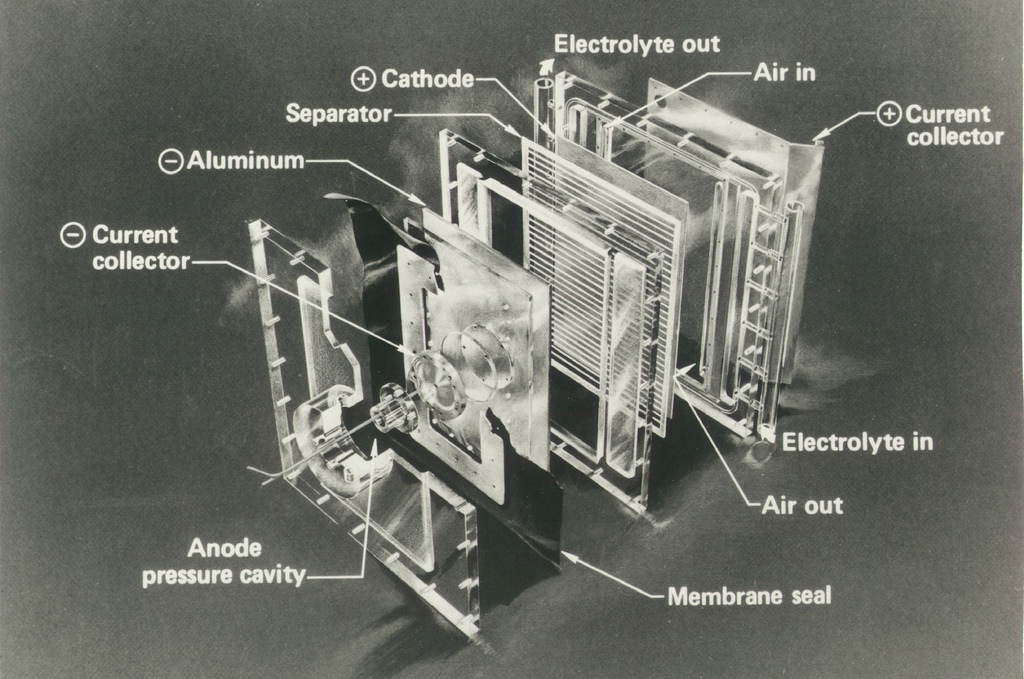
Preview Image: Proposal for Advanced Aluminum-Air Fuel Cell
Video Share Link: https://youtu.be/_FxIzMwOF00