The Globe and Mail posted a piece in March 2017, suggesting a new aluminum-ion battery from Stanford could outperform lithium. The researchers claimed faster charging and longer life, and at a price that most commercial batteries could not beat. Are lithium batteries on their last charge, their reporter asked? We decided to fast forward to discover whether aluminum batteries could indeed disrupt lithium under current market conditions.
How Aluminum Batteries Could Disrupt Lithium
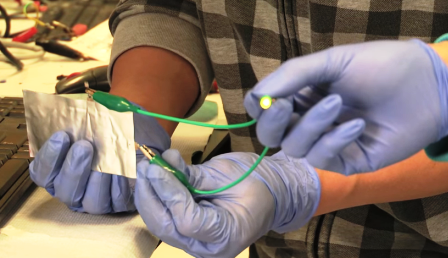
The 2017 Stanford battery combined a negative aluminum anode with a positive graphite cathode. The scientists placed these electrodes in a flexible polymer-coated pouch separated by ionic liquid electrolyte. They hoped aluminum batteries could disrupt lithium ion batteries and other commercial types this way.
“We have developed a rechargeable aluminum battery that may replace existing storage devices. Such as alkaline batteries, which are bad for the environment. And lithium-ion batteries, which occasionally burst into flames,” lead researcher Hongjie Dai claimed.
Unfortunately, It’s Not Always that Simple
A team of scientists at Zhejiang University in Hangzhou, China recently expressed concerns about aluminum-ion batteries. Because they considered the Stanford graphite cathode performance did not hold sufficient promise in its present form.
On February 1, 2018, Chemical Engineering announced the scientists had raised new hopes that aluminum batteries could disrupt lithium. The chemistry is complex. However, we can confirm high-temperature annealing in presence of ‘gas pressure’ produced a ‘highly orientated’ graphene structure.
Performance statistics are impressive. The prototype retains 91% density after 250,000 cycles, with high-rate capability. Moreover, the flexible, nonflammable aluminum battery is stable within an operating temperature range of -40 to +120ºC (maximum 262ºF). That said, the scientists do not believe their battery can yet compete in terms of total density, and production costs.
Therefore it seems that lithium-ion is not on its last charge after all. Although perhaps it should look back over its shoulder, just to make sure that aluminum is not catching up.
Related
Aluminum-Graphite Batteries Challenge Lithium
Perform a Simple Aluminum-Air Battery Experiment
Preview Image: Stanford Lithium-Ion Battery (Screen Shot from Video)
YouTube Share Link: https://youtu.be/ZKIcYk7E9lU