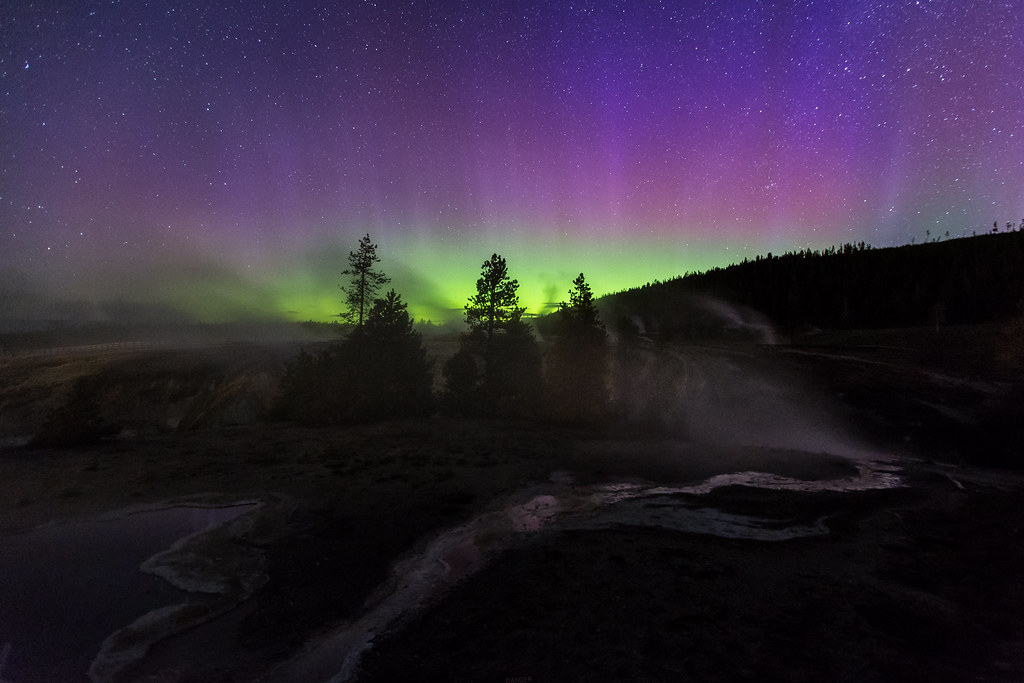
Auroras are natural illuminations we see in the night sky sometimes. When we view them from the northern hemisphere, we call them aurora borealis from the Latin word meaning north. However we call the southern lights aurora australis although they are also charged particles that flew from Sun. Energy really is all around us when we explore.
How These Charged Particles Reach Earth

The temperature at the heart of Sun’s gaseous mass is 27 million degrees fahrenheit / 15 million degrees celsius. This boils and bubbles as plasma escapes from sunspots in charged particles we call solar wind.
These winds travel through space for forty hours until they reach Earth’s atmosphere. Then the charged electrons and protons ionize the atmosphere creating spectacular sights in the night sky. Their actual appearance depends on the degree of the excitation of the atmospheric constituents and the speed of the solar wind. The gas planets around Sun – Jupiter, Saturn, Uranus and Neptune also have their own auroras.
What Causes the Different Colors in Auroras?
The possible colors include pink, green, yellow, blue, violet, and occasionally orange and white. Yellows and greens associate with oxygen in our atmosphere. While red, violet, and occasionally blue colors associate with nitrogen.
Auroras appeared in drawings 30,000 years old, on cave walls in France where people believed they predicted war and destruction. Astronomer Galileo Galilei took a more scientific approach in 1616. He named what he saw after the Roman goddess of the dawn Aurora. However, Aristotle, Descartes, Goethe and Halley, all refer to the northern lights in their work.
On September 2, 1859 two telegraph operators in Boston and Portland found they could communicate during an aurora without their batteries. One said “The aurora seems to neutralize and augment our batteries alternately, making current too strong at times for our relay magnets”. They communicated without batteries for the duration of the aurora. Perhaps someday we will harness that power.
Related
Wind and Solar Could Re-Green the Sahel
SOLAR SPLASH: The UNM Solar Boat Team Interview
Preview Image: Aurora Over Earth from International Space Station