Swiss cheese develops holes after microscopically small flecks of hay fall into milk buckets, and compost during the 130-day process. At least that’s according to American scientist William Mansfield Clark who since passed on. If we slice it thinly we could blow through the holes, but we can’t blow through the block. That’s the way Swiss cheese helps understand pandemics according to Harvard T.H. Chan School of Public Health epidemiologist Bill Hanage.
How Swiss Cheese Helps Understand Pandemics
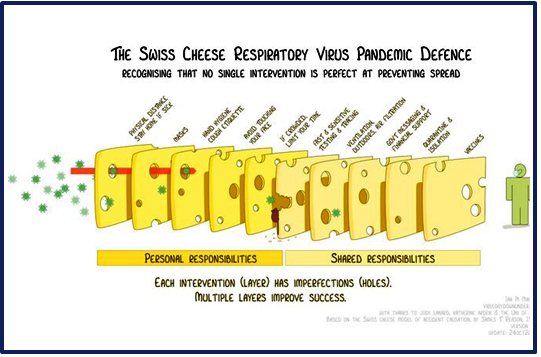
Siobhan Roberts explained the basics in New York Times on December 5, 2020. Pandemics spread because there are holes in our collective defenses. These holes could be ignorance, unwillingness to cooperate, or failings in the social structure. If we wear face masks, socially distance, and disinfect we plug three of those holes.
No single one of these defenses may be perfect. However, when we add testing, tracing, ventilation, and consistent government messaging we start to build a solid barrier. This could eventually quench the transmission of the virus, says Julie Gerberding, executive vice president, chief patient officer at Merck.
Siobhan Roberts Interviews ‘Cheese Man’ Virologist Dr. Mackay
The real power of the infographic, Dr. Mackay explains is the combined effectiveness of multiple layers compared to single protections. Each ‘slice of the cheese’ has its holes, like badly fitting face masks, and people around us misbehaving. Distance is proving to be the most effective intervention, although environment and ventilation can take their toll.
Try not to be in enclosed spaces where infectious droplets can linger, he says. Don’t go grocery shopping as often. Hold off on going out, parties, gatherings. You can do these things later, Dr. Mackay says. Swiss cheese helps understand pandemics and that’s for sure. However, we are less convinced about the hay theory holding true.
Related
Monulparivir Could Stop the Virus in 24 Hours
Using Airflow to Reduce Infections in Autos
Preview Image: The Holes in the Cheese Tweet