Callaud’s gravity cell took early battery research down a detour where specific gravity was the separator. This was an intriguing theory, but we fear very much a hit-and-miss-affair. However, German physicist Johann Poggendorff brought stability back center stage again. That’s perhaps because, as Wikipedia describes him ‘he possessed an abundant measure of the German virtue of orderliness’.
Poggendorff Combines Electrolyte and Depolarizer
Early battery experiments used depolarizers to prevent accumulation of hydrogen gas bubbles. These took up electrons during battery cell discharge, thereby maintaining voltage at a steady high level. But Poggendorff resolved this problem with a simpler solution in 1842.
First, he used dilute sulfuric acid as his electrolyte, just as we do with lead acid batteries to this very day. And then he mixed his polarizer chromic acid with this thoroughly. This meant there was no longer any need to keep them physically separate with earthenware or other material.
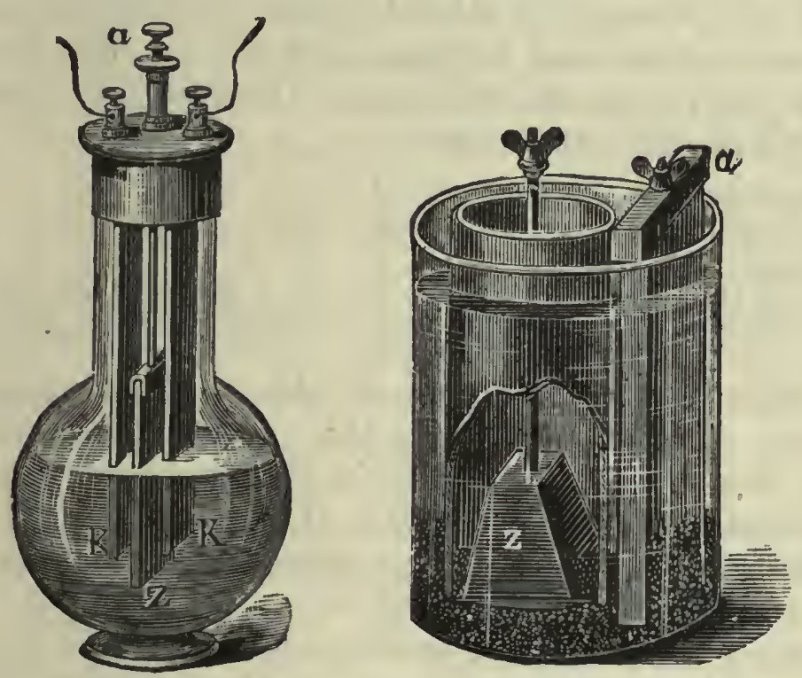
Finally, Poggendorff had another flash of genius. He assembled his cell with two positive carbon plates, and a negative zinc plate between them to form the electrodes. His design included a mechanism to raise the zinc plate above the electrolyte, to avoid degradation when idle.
Poggendorff’s Design Brought Stability That Proved Popular
Johann Poggendorff’s cell was a great success. It was able to deliver a steady 1.9 volts without releasing fumes. Thus researchers used it for decades during their experiments. Although the fragile glass container, and the need to raise the negative electrode made it unsuitable for commercial use.
Innovations on the theme followed, after Johann Poggendorff brought stability to early electro chemical cells. These became known as ‘bichromate’ and ‘chromic acid cells’. Great ideas have their place in time. However, as we shall see they all eventually give way to later advances.
Related Posts
Callaud’s Gravity Cell Eliminates Porous Barrier
Daniel and Dancer Improve on Volta’s Design
Preview Image: Portrait of Johann Poggendorff