Scientific American recalls when Yan Wang began investigating recycling batteries eleven years ago, critics questioned whether there were enough of them to make it worth it. Nowadays he occupies the chair of materials science professor at Worcester Polytechnic Institute Massachusetts, and he has an abundant supply! The Institute announced his recycled lithium cathode outperforms new products by a margin. How does he manage that?
Traditional and Novel Ways to Recycle Lithium Batteries
Scientific American advises the commonest method of recycling lithium batteries starts with dismantling and shredding the product. Recycling proper begins by reducing this to a black goo, or powder by either melting it down or dissolving it in acid.
The next stage involves salvaging chemical elements or simple compounds. These then re-enter the manufacturing supply chain alongside newly mined elements to make cathodes.
However, Wang and his colleagues have diverted somewhat from this process at Worcester Polytechnic Institute. They reasoned if the critical elements are in the cathodes where lithium ions gather, why not rather focus on these instead?
Their Recycled Lithium Cathode Outperforms New Ones
First, Wang and his colleagues shredded old lithium batteries. But then they set aside the electronic circuits, steel battery casings and other low-value debris before continuing.
1… First they dissolved the cathode material in acid and then removed impurities.
2… Next, they added top-ups including nickel and cobalt to restore ingredient ratios.
3… And finally they produced an effectively refreshed cathode powder of tiny particles.
The team then used physical tests, imaging, and computer simulations to benchmark their cathode materials against new ones. Worcester Polytechnic Institute says their recycled lithium cathode outperforms new commercial models, and appears to be a potentially green and profitable resource for battery producers.
Related Posts
A Battery Fit for Sweltering Australian Outback
Lithium Battery Recycling Venture in Norway
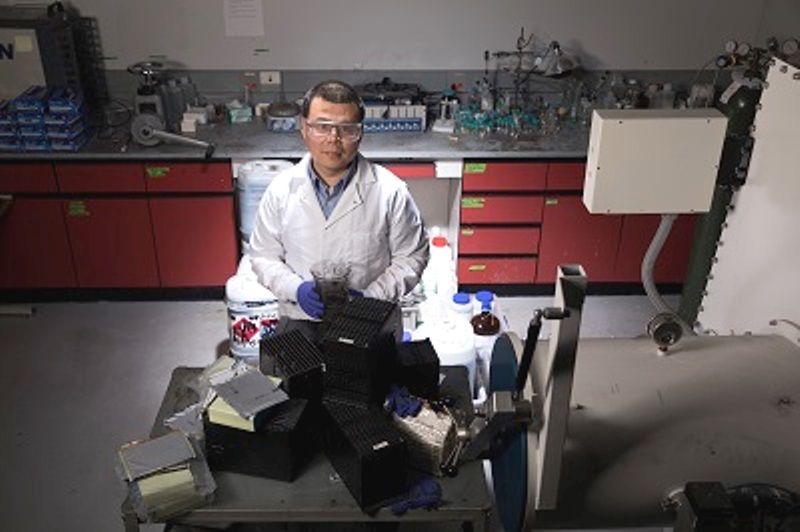
Preview Image: Prof Yan Wang in his Laboratory