


With the wisdom of hindsight, it was becoming clear that battery development needed to take a lateral step in a new direction. William Grove may have been thinking of this when he created the first fuel cell ‘gas voltaic battery’ in 1842. However, we are jumping ahead of ourselves again. Because today’s topic is the Grove Cell he invented three years earlier to a mixed reception.
The Inventor and The Grove Cell
William Grove was both a Welsh scientist, and a solicitor who became a judge in his later years. He already had his mind around the theory of the conservation of energy, before it became popular. But the world of science came to him almost naturally when he studied ancient Greek and Roman literature.
The theory of electric cells grew on him after he attended the Royal Institution in London in 1829. Ten years later – and apparently working largely in isolation – he conceived his unique Grove Cell for electrical energy storage. This had a mixed reception, although it did open the door to new materials.
The Chemical Composition of the Cell
William Grove intuitively came up with the idea of using zinc and platinum electrodes for his battery.
- The negative anode was zinc, standing almost immersed in sulfuric acid.
- While the positive cathode was platinum, almost immersed in nitric acid.
- A porous ceramic pot separated the two, while allowing ions to exchange.
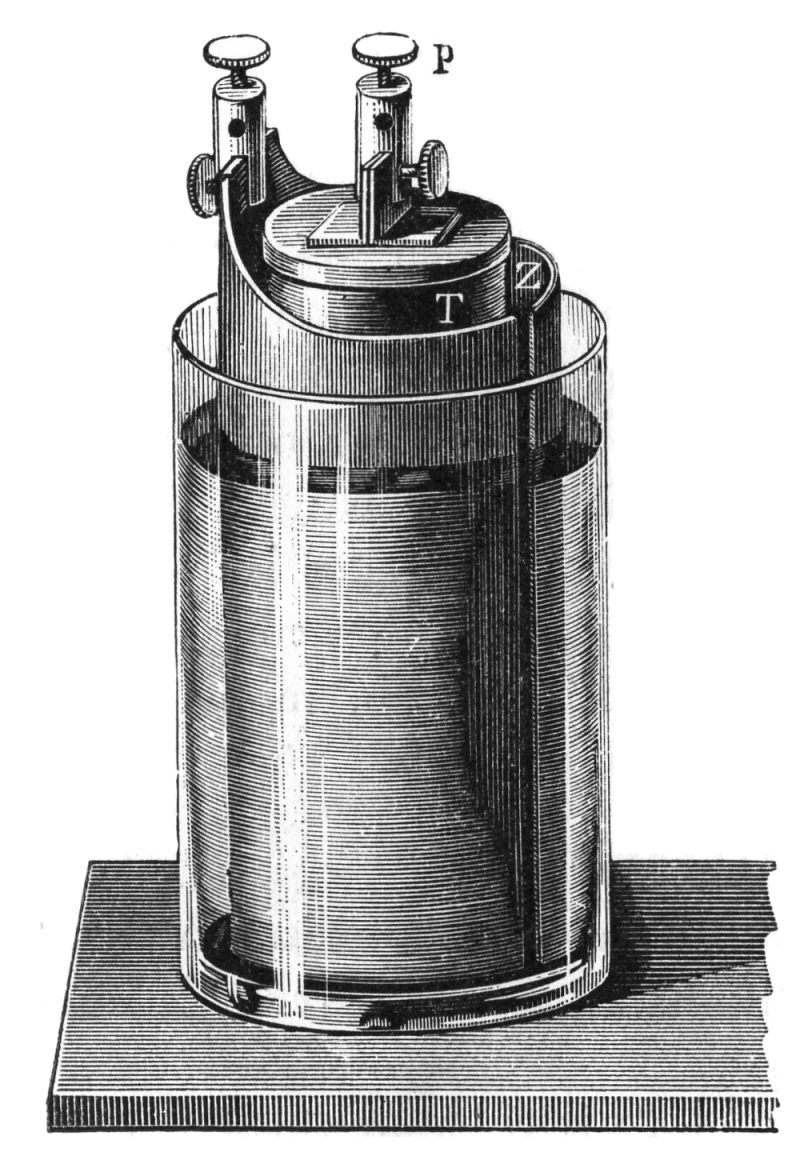
This arrangement generated a high current, and almost double the voltage of the Daniell cell. The American telegraph networks were excited for a while, before they moved on after they encountered these problems:
- The battery emitted poisonous nitric oxide fumes while operating.
- The voltage fell sharply as the cell surrendered its stored energy.
- This was a growing problem as telegraphy became more complex.
- Platinum metal was too prohibitively expensive for mass production.
Yet despite the disadvantages of early batteries, the search continued onward. Science was sensing the key role batteries would play in the evolution of future technology.
More Information
The Poggendorff Cell on the Sidelines


