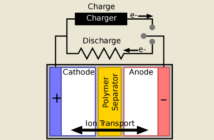
Conventional batteries contain anodes, cathodes, separators, and electrolyte in one containment. Flow battery technology changes these rules. That’s because redox flow batteries exchange ions between liquids through a membrane in separate tanks. We explain the basics of this system in a high-level introduction.
The Redox Chemical Reaction in a Flow Battery
A redox reduction-oxidation reaction involves an exchange of electrons between two materials, one of which has a greater standard potential to attract electrons than the other, via an electric circuit. Chemists call the gain a reduction, and the loss an oxidation. This sounds odd on first glance, but allow us to explain.
The flow of electrons is achieved by pumping two tanks of active liquids past a single ion-selective membrane between them. Exchanging electrons upsets the chemical balance in the flow battery. Compensating ions therefore flow in the opposite reaction via the membrane. As a result, the tank that received the additional electrons, also experiences a reduction in ions.
More About the Inner Workings of the System
A flow battery is a rechargeable fuel cell, in that flows of electrons and ions can be reversed. In this way, it can convert chemical energy to electrical energy, and vice versa. Hence, electrical engineers include it in the family of electrochemical cells, despite the differences in design.
The Advantages of Flow Battery Technology
- Flow batteries are scalable, simply by increasing tank capacity.
- Therefore, they can be purpose-built for particular applications.
- They have long lives too, because there are no solid-to-solid transitions.
- There is no need for equalization, because they are a single cell.
- They have quick response times, no emissions and little self-discharge.
- Their electro-active materials are all recoverable and recyclable.
However, they also have several disadvantages too:
- A flow battery has low density, meaning we need large tank sizes.
- Charge and discharge rates are low, implying large electrodes and separators.
- Flow batteries also have low energy efficiency, since they operate at high current densities.
These large electrochemical cells therefore perform best in energy dense applications. Here we think of data center back-up, peak load-shaving, power conversion, and large electric vehicles.
More Information
Battery Chemistry and What It Is All About