We are more than half way through yet another year, that seems to have passed by faster than ever before. We decided this was an opportune moment to update our readers with an electric vehicle battery review as things stand. So we have a tantalizing glimpse of what may lie ahead, and look forward to the possibilities this brings.
Critical Factors Driving Electric Vehicle Batteries
No electric vehicle battery review would be worth its salt, without us understanding what battery developers are aiming for. High-power-to-weight, and high-energy density-to-weight are the benchmarks by which the industry rates emerging batteries.
Clearly, the weight – and the size – of vehicle batteries have a bearing on their energy and density-to-weight ratings. Although to most consumers these equate to the acceleration and driving range they experience.
Lithium batteries compete best with liquid carbon fuels on these scores, and so they dominate the market. Lithium-nickel-manganese-cobalt-oxide types are the commonest variety of these batteries, although lithium-iron-phosphate varieties are catching up fast.
Lithium-iron-phosphate batteries are heavier, but they cost less. They also more environmentally responsible and sustainable, although they may never achieve ‘super car status’. But now sodium-ion batteries are showing promise of being the industry ‘gold-standard’ of the future, because they do not use critical materials.
Review of Electric Vehicle Battery Manufacturing
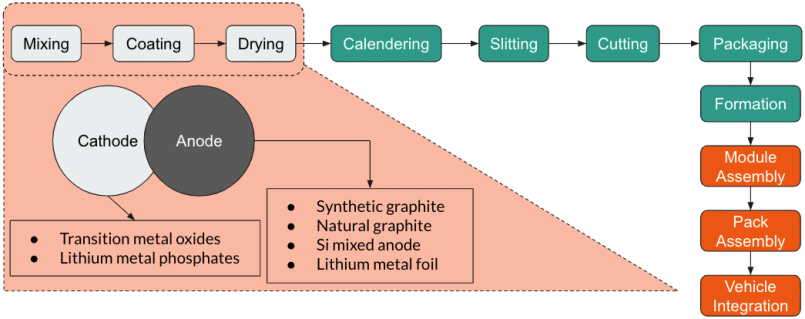
There are three broad stages to manufacturing electric vehicle batteries. First, suppliers prepare the raw materials. Then these materials go to sub-component manufacturers who prepare individual cells. And finally, battery makers integrate these cells into the large electrical vehicle batteries we have come to know well.
Reusing and recycling electric vehicle batteries have become a critical part of their life cycle. This is because battery raw materials are not always abundant, and extracting and refining them adds to the battery carbon footprint.
We need to think carefully about these things, as we navigate through global warming. Every consumer product that we touch and feel, leaves a carbon footprint in the atmosphere. Let’s do what we can, every one of us, to live responsibly starting now.
More Information
Sodium-Ion Battery Revolution Is Approaching