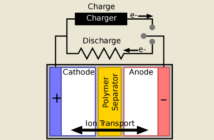
When Volta invented the first electro-chemical battery in 1799, he used alternating discs of zinc and copper as electrodes. Planté continued with the theme in 1859, with a lead-acid battery containing alternating plates of metallic lead, and lead oxide. Anode-free metal batteries ask why we still need to build both electrodes, when one will do perfectly well to begin with.
Why We Need Anode-Free Metal Batteries Now
The world needs smaller batteries that are cheaper and lighter. That way we can fit more of them into a given space while saving money. We need to be able to do this before we can electrify ocean and air transport. As well as build all the battery storage farms we need.
How Do Batteries Work Without Anodes?
The anode and cathode in a conventional battery work together to produce energy from an electrochemical cell. The anode begins the process by releasing its electrons to the external circuit. While the cathode receives these at the other end of that loop. However, the efficiency of this process depends on how well the two electrodes team up.
A battery without an anode begins it life with just a cathode electrode. However, the first time it receives an external charge, it creates a metal anode using charge carriers from the cathode. These charge carriers are particles that are free to move with an associated electrical charge.
More About Batteries That Begin Without Anodes
Anode-free metal batteries usually have solid-state electrolytes of polymer or ceramic material, although some use graphite. This design prevents dendrites gradually forming on the anode current collector, and eventually short-circuiting the electrodes.
The charge carriers from the cathode, electroplate the active material on the anode current collector, thereby creating a solid electrolyte interphase. Thereafter, the battery that did not have an anode originally, functions just like a regular battery.
More Information
Anode-Free Battery Defies Convention