Battery scientists believed for decades that the film forming on rechargeable lithium battery electrodes was a bad thing. They thought this solid–electrolyte interphase, as they called it, obstructed the flow of ions and degraded battery performance. We now know this is not the whole truth, thanks to a September 28, 2023 report in Nature Energy. Could this be a turning-point for lithium technology?
The Solid–Electrolyte Interphase Does NOT Cause Performance Loss
Sci Tech Daily confirms our understanding that the solid–electrolyte interphase (SEI) does not directly lead to lost battery performance. That’s because it is actually a by-product of the process, or a reflection of this happening.
The scientists who wrote the report developed a world-first way to directly measure the electrical properties at the SEI boundary. This is the point where the SEI and the liquid electrolyte meet, inside rechargeable lithium batteries.
The team from U.S. Department of Energy’s Pacific Northwest National Laboratory, discovered the SEI layer was not an insulator. Instead, it acts as a semi-conductor during lithium battery operation. This poses the question of how to improve the layer’s performance.
The Knock-On Implications of This Discovery for Lithium Technology
Sci Tech Daily believes the discovery has direct implications for designing longer-lasting lithium batteries, by fine-tuning their liquid electrolytes. “A higher rate of electrical conductance [currently]induces a thicker SEI with intricate solid lithium forms,” agrees the study leader, “ultimately leading to inferior battery performance.”
The solid–electrolyte interphase is actually thinner than tissue paper, and forms during the first charging cycle. It should theoretically remain stable. However, mossy or tree-like deposits may form on it as a lithium battery ages, and often causes degraded performance. Applying the new technology should help avoid this, and lead to longer battery life.
More Information
The SEI Layer Inside Lithium Batteries Explained
Priming Battery Anodes Improves Prelithiation
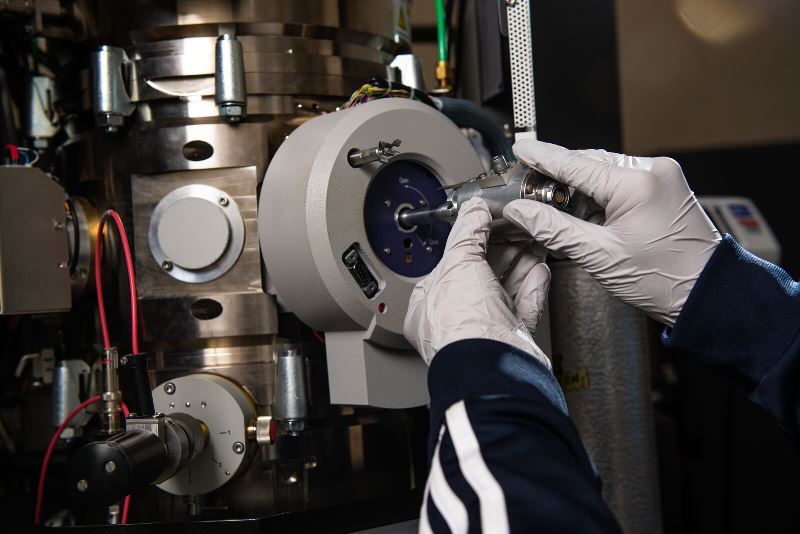
Preview Image: Observing Battery Materials Evolve
Pacific Northwest National Laboratory Press Release