We published a post yesterday concerning the LG Chem thermal insulator, that halves the risk of lithium-ion battery thermal runaway. At the time, we understood that the micro-thin sheet temporarily suspended cathode conductivity. Although how the LG Chem thermal blocker achieved this in practice, was not clear in our minds and so we decided to investigate further.
How The LG Chem Thermal Blocker Works in Practice
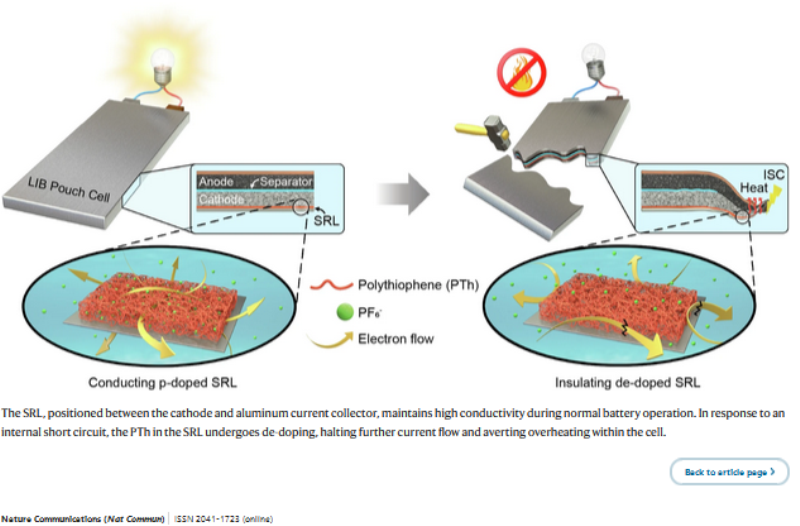
The ultra thin layer separates the anode and the cathode current collectors. But it allows current to flow between these two electrodes at safe temperatures. However, the layer’s resistance increases as battery temperature rises. Then it blocks the flow of current completely, when that temperature reaches a critical point.
But this process does not affect overall performance of the lithium-ion battery. Instead, the ultra thin layer’s resistance gradually reduces, as the battery temperature returns to a safe level.
LG Chem cautions that this does not happen every time. Although the prospect of 50% less lithium-ion battery fires sounds like a great step forward. The report in Nature.Com identifies two potential ways to prevent lithium-ion battery overheating, and so counter thermal runaway:
- Adapt electrolytes or separators with thermo-responsive polymers, to suppress ionic current flow.
- Introduce positive thermal coefficient (PTC) materials, that interrupt ionic current flow when heated.
- The latter approach facilitates ‘rapid ion doping / de-doping’, as opposed to bulk phase changes.
History of Positive Thermal Coefficient (PTC) Materials
The research report that we link to below, chronicles ongoing attempts to perfect these PTC materials. Proofs of concept date back to 2010, however the ongoing challenge has been adapting these ideas for high volume, high speed production.
Therefore, the team focused their minds from the outset on how their LG Chem thermal blocker would adapt to mass production. Although various conductive polymers were available, they chose polythiophene as the most cost-effective, practical solution for mass battery production.
More Information
Battery Thermal Safety Layer Cools Runaway
Flame Resistant Battery Casings in Transit