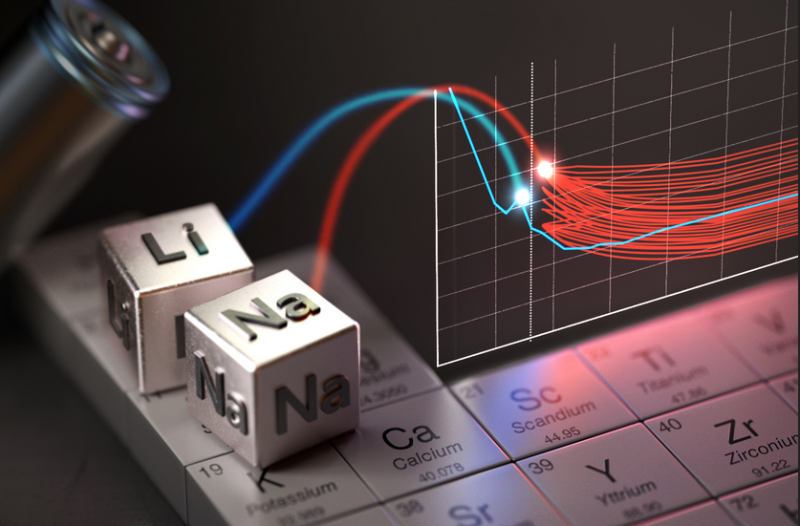
For several decades, battery scientists have searched for alternatives to lithium-ion batteries. Their reasons are numerous, although the pressing ones include latent instability, and questionable sources for raw materials. But now a team from Princeton’s Dincă Group believe they may have found an replacement, in the form of a high performance sodium-ion cathode.
The Dincă Organic High Energy Sodium-Ion Cathode
The Dincă Group’s novel, organic, high power cathode could be a step towards a safer, cheaper alternative to lithium-ion batteries. Their potentially rapid progress runs counter to years of frustrating earlier efforts.
Previously, similar attempts were frustrated by relatively lower energy density, and shorter run times between charging. Researchers may have wondered whether they would ever achieve simultaneous high power and high density with sodium-ion.
We’re not sure how the Dincă team narrowed their search down to an organic, layered, bis-tetraaminobenzoquinone high performance sodium-ion cathode. To be honest, we never even heard of this material before.
So we dived into Google, and discovered that bis-tetraaminobenzoquinone is a fused, conjugated, highly-conductive molecule, with a layered solid-state structure. And moreover, that it outperforms lithium-ion when used as a sodium-ion cathode.
Where to From Here With Dincă Group’s Novel Cathode?
Well, bis-tetraaminobenzoquinone is a completely insoluble material, that is impossible to dissolve. And the fact that it is highly conductive, makes it a natural organic cathode material.
“It’s always better to have a diversified portfolio for these materials [than having to rely on lithium]”, explains project leader Mircea Dincă. “Sodium is literally everywhere.
“For us, going after batteries that are made with really abundant resources, like organic matter and seawater, is among our greatest research dreams. Being on the front lines of developing a truly sustainable and cost-effective sodium ion cathode or battery, is truly exciting.”
More Information
Sodium Ion and Lithium Ion Batteries
New Boost to Sodium-Ion Battery Performance