Researchers at University of Texas have discovered a transient hidden interphase in metal anodes, that could improve their life cycles. This interphase takes the form of a thin film that appears on these electrodes when they are active. Scientists previously assumed this was a persistent phenomenon. However, it now appears that it eventually dissolves, as its saturation diminishes.
Transient Hidden Interphase Appears During Rapid Discharging
Tech Explore confirms the conclusion that this temporary layer smooths over the anode surface, during rapid discharging. This in turn protects the electrode from ‘harmful abrasiveness’ that could cause what the author refers to as ‘long-term issues’.
Now if we could harness this technology in practical terms, imagine what this might do for the performance of our electric vehicles and smartphones. There’s no reason we can think of, that this discovery should not benefit large scale energy storage too.
“By controlling this transient interphase, we can design batteries that perform better under high-demand conditions, last longer, and are less prone to failure,” a university spokesperson explains. This particular study therefore focuses on the discharge process, which receives less attention in the literature than the charging one.
“Before I joined University of Texas,” a team member explains. “I spent my entire career looking at the recharge process. But I wanted to study the other side of the equation,” remarks another participant.
Exploring Aqueous Batteries With Metal Anodes
The University of Texas team chose a battery with a primarily-water-based electrolyte, for their experiment. This ensured their battery could not catch fire, if they disturbed the ions with too high a charge.
The researchers were able to replicate the hidden interphase in metal anodes on demand, using a rotating disc electrode. And sure enough this thin film vanished, when they rested their battery leaving a flat clean surface.
The temporary layer that appeared this way during high-speed charging, reduced surface roughness by 42%. This temporarily improved battery efficiency and durability, according to the University of Texas announcement we link to below.
More Information
Battery Thermal Safety Layer Cools Runaway
The SEI Layer Inside Lithium Batteries Explained
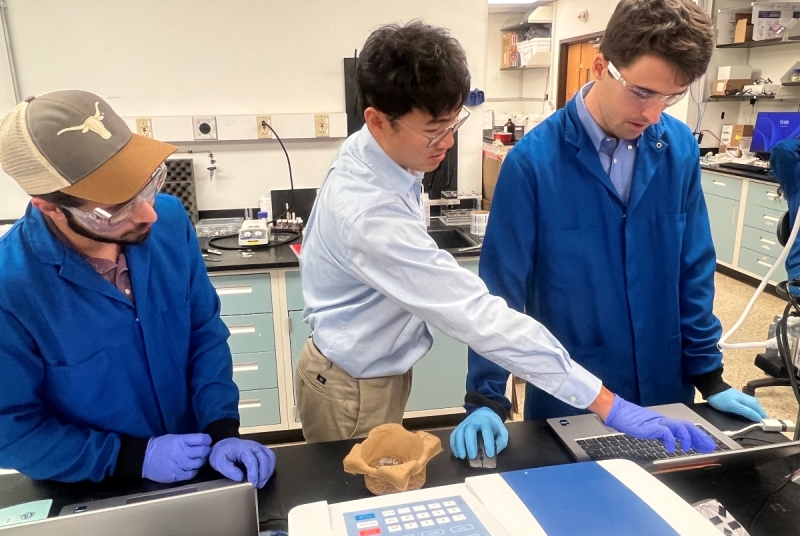
Preview Image: A University of Texas Laboratory