If we wish to slow climate change, then we must drastically reduce our carbon emissions. This is one of the enigmas of batteries. They can store renewable energy for future use, but their manufacture leaves a carbon footprint behind. Nickel metal plays a critical role in lithium-ion batteries. Scientists have found a way to source green nickel for sustainable electrification.
Sourcing Green Nickel for Sustainable Electrification
Scientists at Max Planck Institute for Sustainable Materials in Düsseldorf, Germany, have found a carbon-free way to extract nickel from low grade ores. This resource was previously inaccessible due to its complexity.
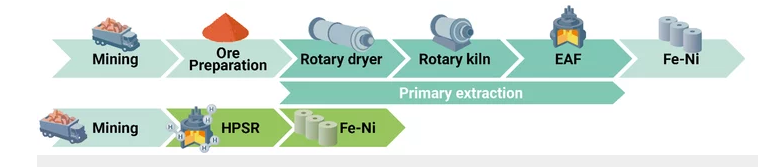
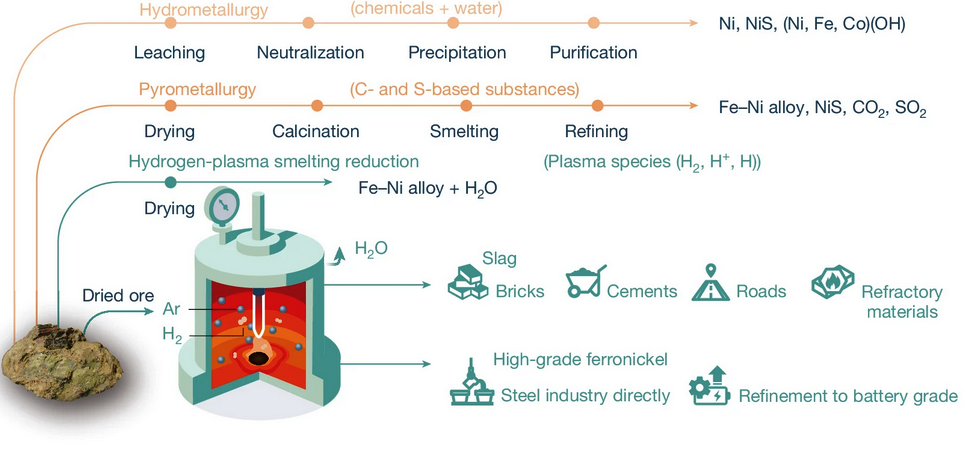
The nickel industry currently relies on high-grade ores as their source for the metal, using either of these two high energy extraction methods:
- PYRO-METALLURGY: Separating the nickel from the ore using high heat to smelt it, and separate the metal.
- HYDRO-METALLURGY: Leaching the nickel from the ore using water-based solutions and chemical reactions.
Max Planck has developed an alternative, single-step process, using hydrogen plasma as their energy source instead. Their new procedure reduces carbon dioxide emissions by 84%, after factoring in the impact of mining and transport.
The developer claims their renewable electricity and green hydrogen process, is also up to 18% more energy-efficient. This saving is possible, because their hydrogen plasma method does not repeatedly heat and cool the ore.
More About The Green Hydrogen Plasma Process
The alternative method separates out green nickel for sustainable electrification in a single step. This technology is advanced, but we’ll do our best to explain it in simple terms.
Hydrogen plasma is a high-energy state of hydrogen gas, where the atoms have been ionized according to Science Direct. This process produces a collection of protons and electrons. These have unique properties, such as high energy densities, mean proton energies, and electron densities.
The Max Planck Institute for Sustainable Material substituted hydrogen plasma as their energy source. This allowed them to separate the nickel from the low-grade ore in a single reactor furnace. Smelting, reduction, and refining occurred simultaneously, directly producing a refined ferro-nickel alloy.
More Information
High-Nickel Lithium Battery Runaway Tamed
Lithium Nickel Oxide Degradation Discovery
Preview Image: Using the Electric Arc Furnace
Press Release from Max Planck Institute