

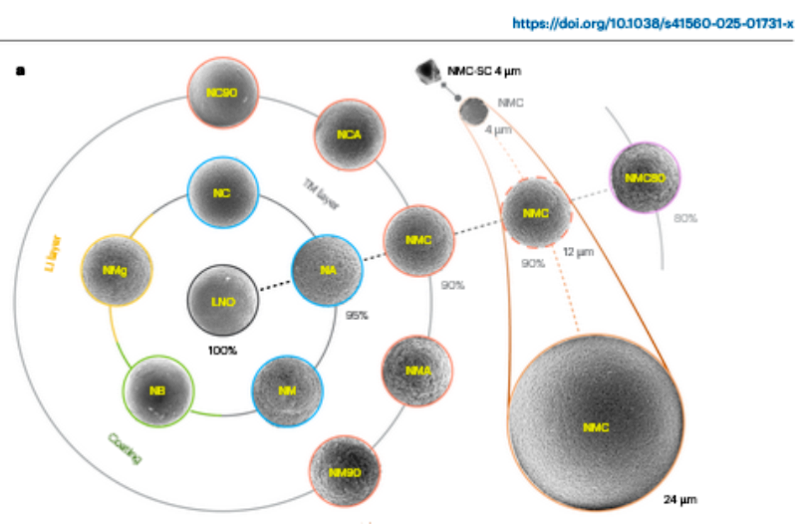
Scientists at Walker Department of Mechanical Engineering, and Texas Materials Institute at University of Texas, are exploring electric vehicle batteries. They have been following a pathway to safer nickel batteries as part of their research. That’s because this metal is more abundant and easier to obtain than widely used cobalt, and holds more energy.
Safer Nickel Batteries Could Mean Longer Driving Ranges
However, nickel in its raw form is less stable than its competition, in terms of cycle life, safety, and thermal stability, the scientists caution. Therefore, they are delving deeper into the potential for nickel-based battery cathodes.
“High-nickel cathodes have the potential to revolutionize the EV market by providing longer driving ranges,” a spokesperson assures. “Our study provides a comprehensive analysis of nickel thermal stability, which is crucial for developing safer batteries.”
Their work is highly detailed, as they assessed 15 high-nickel cathode materials in terms of over 500 criteria. During this process they unearthed two fundamental facts in the pathway to safer nickel batteries:
- Each cathode material has a critical state of charge, that defines its safe operating limit.
- The strength of metal-oxygen bonds and surface reactivity, influence this crucial state.
After the cathode materials exceed this critical state of charge, they become unstable. This could trigger catastrophic thermal runaway, the researchers caution. This condition could “further heat the battery, substantially increasing the risk of failure, and / or fires”.
New Thermal Stability Index Quantifies Heat Runaway
The researchers developed a thermal stability index. This measure incorporates cathode composition, surface chemistry, nickel content, and crystal size.
This is an important step forward for battery science. It offers a pathway to safer nickel batteries that are also more efficient, and can therefore support the growing demand for electric vehicles.
“Our work provides a road map for the industry to follow,” comments a member of the team. “Ensuring that the high energy density of these cathodes does not come at the cost of safety.”
More Information
Lithium Nickel Oxide Degradation Discovery
Stabilizing High-Nickel Cathodes For L-Ion
Preview Image: The Nickel Road Map


