Zinc-ion batteries use zinc-ions as their charge carriers. These charges shuttle between zinc-metal anodes, and zinc intercalating cathodes. Current collectors in batteries are usually thin conductive foils, that support the active materials in electrodes. Scientists at Dongguk University in Republic of Korea, have developed a novel current collector for zinc-ion batteries.
Why Do We Need the Novel Current Collector Now?
The past 20 years have seen a surge in interest in sustainable forms of energy. Solar and wind power need robust battery storage systems, to cover for them after dark. Lithium-ion batteries currently dominate battery energy storage, but they are prone to critical safety issues.
Zinc-ion batteries could potentially replace lithium-ion batteries in energy storage systems, thanks to their affordability, safety, high capacity, and compatibility with water-based electrolytes. However, they do not up-scale readily, and have poor mechanical properties which are holding them back.
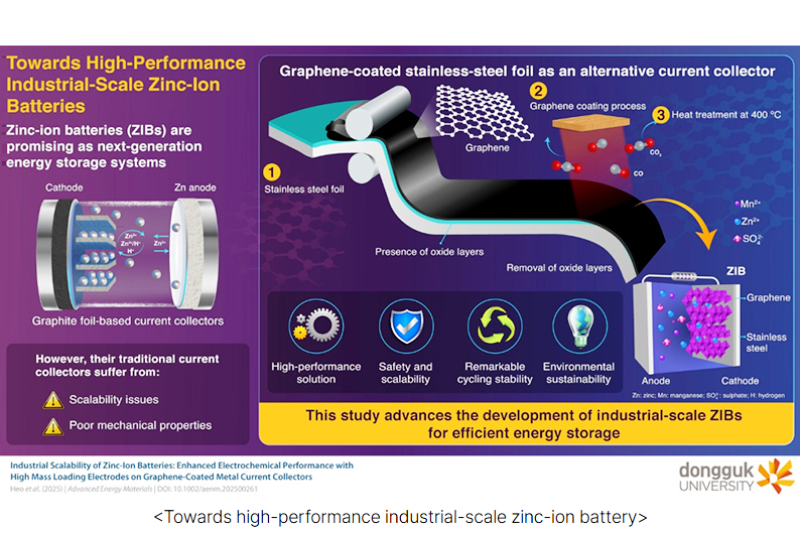
The scientists at Dongguk University discovered a novel current collector for zinc-ion, in the form of a robust graphene-coated stainless-steel foil.
This modification resolves mechanical weakness, and delivers “high electrochemical performance and superior cycling stability, potentially paving the way for industrial-scale systems”. We provide links to their media release and research report below.
Resolving Zinc-Ion Current Collector Weakness
The Dongguk University researchers believe their solution “overcomes the common challenges of corrosion, and poor conductivity seen in water-based systems”.
It also “operates stably even under high-mass loading conditions”, they continue, that are so essential for robust battery storage systems. Capacity retention is excellent too, at 88.7% after 1,500 discharge-recharge cycles.

“This technology is highly suitable for grid-scale energy storage systems,” the project leader wraps up. “Especially since we use water-based electrolyte. This provides a non-flammable, cost-effective, and environmentally friendly alternative to traditional lithium-ion systems.”
More Information
Aqueous Zinc-ion Batteries Back on Table
Aqueous Zinc-Ion Battery Breakthrough
Preview Image: The Novel Current Collector