There’s a new word in the battery lexicon, and it is ‘upcycling’. Scientists use this term in the context of upcycling instead of recycling batteries. After all, they ask, why use an expensive process to recycle spent battery materials to their original state? When you can simply upcycle them for another purpose? This makes a deal of sense to us, if it is practical.
How Upcycling Spent Battery Material Works
The best way to explain this process would be to use the research that inspired this article. A team from Pusan National University in South Korea, were concerned that recycling lithium-ion batteries is not proving practical.
This was due to the complex procedures involved, as well as the high costs and environmental concerns. Why not, the team asked themselves, find a new way to use spent battery materials in their current condition instead?
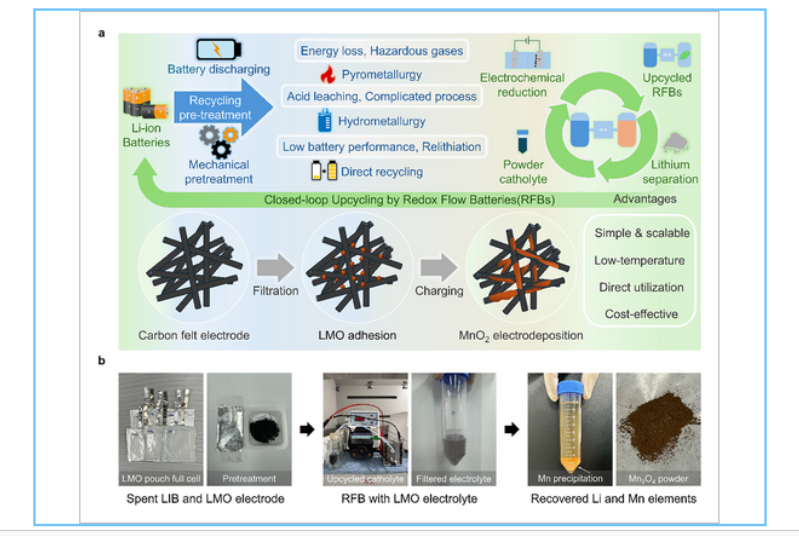
That was the moment they stumbled over the idea of upcycling instead of recycling batteries. The team chose to prove their point with used lithium manganese oxide material, commonly used in lithium-ion battery cathodes.
The South Korean scientists first electrochemically converted the used lithium manganese oxide, to manganese ions. Then they successfully incorporated these as electrolyte for a redox flow battery.
‘The Secret Sauce’ That Avoided Recycling
The lithium manganese cathodes contained both lithium ions and manganese ions initially. However, the researchers only needed the manganese ions for their redox flow battery electrolyte.
And so they first adjusted the electrolyte pH factor to separate the lithium-ions for another purpose, and they were almost there. We never imagined upcycling instead of recycling batteries could be that simple!
There was one more step left in this remarkable experiment. The South Korean team added a double membrane to their redox flow battery. This yielded 90% coulombic efficiency, and 70% energy efficiency after 250 cycles. The idea does work in practice!
More Information
Flow Battery with Simple Organic Electrolyte
Flow Batteries for Long Energy Storage
Preview Image: Conventional Recycling Versus Upcycling