Battery scientists at Helmholtz-Zentrum Dresden-Rossendorf (HZDR) in Germany, have investigated ageing in sodium-zinc molten salt batteries. They now understand how and why this process occurs. Could this be a preamble to slowing the decay in these otherwise promising high-temperature batteries?
Aging in Molten Salt Sodium-Zinc Batteries
Previously one could only try to deduce why these batteries lose efficiency and durability while in use. The HZDR researchers achieved a break through, when they used in-operando x-ray radiography to observe functioning batteries at approximately 600º C / 1,100º F.
For the first time ever, the team from Dresden saw layers separating inside their high temperature batteries. This finding reveals an important cause of ageing in molten salt sodium-zinc batteries, that has been holding the technology back.
What They Saw Using X-Ray Radiography
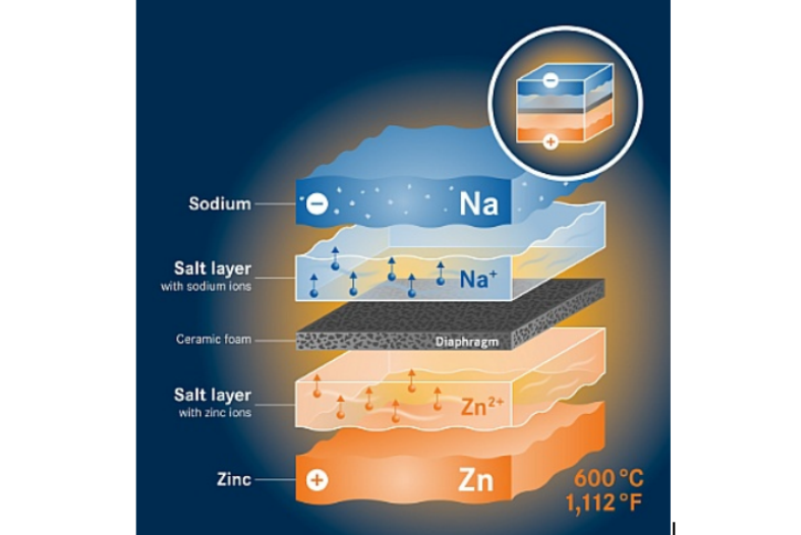
The x-ray technique revealed something unexpected in the porous separating layer that keeps the electrodes apart. They noticed zinc particles accumulating irreversibly in one area.
“It’s a bit like material getting stuck in a sieve,” a team member explains. “Over time, more and more active zinc is lost – a mechanism that helps explain cell aging.”
The researchers are currently investigating ways to improve control over the transport of substances between the liquid phases. They hope to produce a robust solution enabling the use of sodium-zinc molten salt batteries in energy storage.
We now understand how and why premature ageing occurs in sodium-zinc molten salt batteries. Could this be a preamble to slowing the decay in these otherwise promising high-temperature batteries?
Why The Interest in Sodium-Zinc Batteries Now?
Sodium-zinc molten salt batteries appear on paper as promising candidates for stationery energy storage, except they may age too fast. “These systems have great potential because sodium and zinc are inexpensive and easily available,” a lead researcher explains.
“At the same time, we had no clear understanding of why the cells lose so much of their efficiency during use.” This valuable research is now closing this knowledge gap. This is a rare example of a separator influencing battery performance.
More Information
Zinc and Vanadium For Grid Scale Storage
Aqueous Zinc-ion Batteries Back on Table
Preview Image: Molten Salt Sodium-Zinc Battery