When you read our article title ‘zwitterions make faster batteries’ you may have thought we were promoting a particular product. Nothing could be farther from the truth. Zwitterions are ions that contain an equal number of positive and negative charges. So they could have the better of both worlds.
What Zwitterions Could Do For Batteries
Researchers at Oak Ridge National Laboratory have found a way to make better polymer electrolytes using superior ion groups.
They achieved this by carefully controlling the chemistry in a lithium salt-based polymer material, enabling super fast ion transport.
This is how zwitterions made faster batteries in their laboratory, but we’ll get to that in a moment. Speed is key in our world of energy storage, so ions move fast between electrodes during charging and discharging.
This need was less of an issue in the days of liquid or gel electrolytes, but with solid electrolytes that’s another matter. Efforts to solve this challenge with ceramic electrolytes work in principle, but they are brittle and hard to process.
The Oak Ridge scientists have done away with these issues, by developing a super-ionic polymer material, with additional zwitterions.
These ‘hybrid ions’ enable active battery ions to travel 10 billion times faster than their surroundings. But this is without the limitations of liquid, gel, and ceramic electrolytes.
The Blend of Zwitterions Was The Key
This research succeeded, because the scientists added a precise concentration of zwitterions to a polymer material.
You’ll recall these macro-molecular building blocks carry both positive and negative charges. And this increases local polarity but results in a zero charge overall.
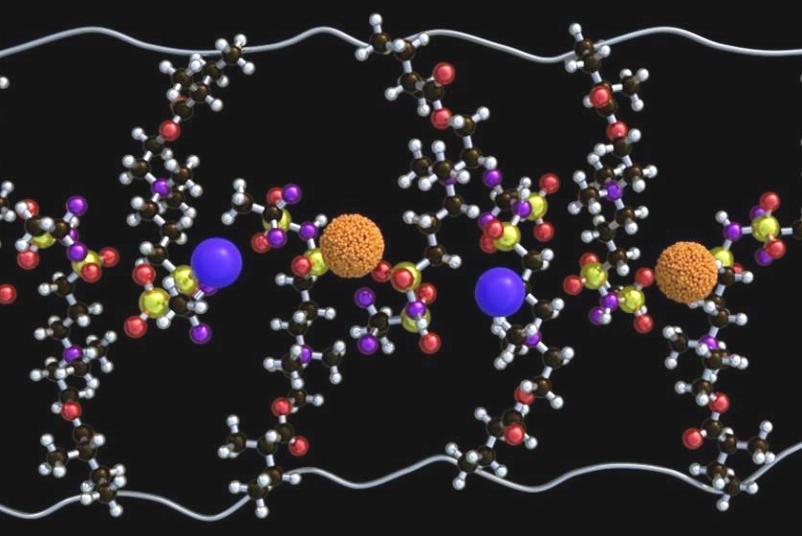
The team then found a way to allow zwitterions to group in pockets, where the active ions could flow optimally. At this point, they formed into ‘channels’ that allowed the active ions to pass speedily through.
More Information
Solid Polymer Electrolyte Material
Electrically Conducting Polymers Shuttle Fast
Preview Image: Zwitterionic Groups Form Pathways