Proton batteries are making waves, because they hint at safer, faster, lower-cost alternatives to lithium-ion. Their super-quick response times line them up for energy storage and fast-responding power applications.
Steady On… What Exactly Are Proton Batteries?
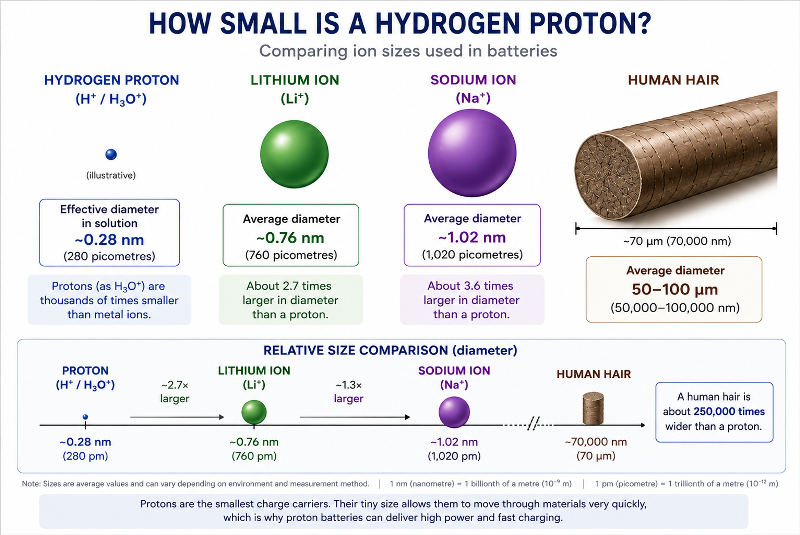
Proton batteries are an emerging class of rechargeable batteries, that use hydrogen ions (protons) as their main charge carriers. These protons are more efficient than larger lithium and sodium ions, and that’s exciting!
In fact, protons are the smallest possible ions, meaning they can move through battery materials extremely quickly. Proton batteries are making waves, because they could lead to very fast charging and discharging.
Most proton battery developers focus on aqueous proton batteries, using water-based electrolytes. These are attractive, because water is non-flammable, inexpensive, and environmentally friendly. Other scientists are exploring organic electrode materials, in order to avoid using scarce metals.
More About These Batteries Making Waves
Proton batteries combine safety, low cost, and high power output in a single package. Recent studies confirm they are capable of retaining useful capacity after more than 10,000 charge-discharge cycles. This means they could become incredibly useful in grid-scale energy storage.
Proton batteries may be making waves as we suggest, although they are still largely at the research stage. Remaining challenges include battery component corrosion, maintaining high energy density, and developing cathodes that efficiently store and release protons over many years of operation.
So Where Do We Go From Here?
Researchers are actively working on these troublesome issues. One promising 2025 study, reported an aqueous proton battery using organic materials, that delivered strong performance at high charging rates. Amazingly, it remained operational after 10,000 cycles.
So yes, proton batteries are definitely worth keeping our eye on, because they may (eventually) offer a safer, lower-cost alternative to lithium-ion. The gates are definitely opening for fast renewable energy storage, linked to long cycle lives.
More Information
High Performance Proton Battery in Laboratory