Researchers at University of New South Wales in Sydney, Australia, have developed a high performance proton battery in their laboratory. Their report in Wiley Online Library that we link to below, claims 307 mAh specific capacity, and 3,500-cycle stability. This appears to represent a significant milestone in proton battery technology.
Proton Prototype Performs Well Across Critical Dimensions
The University of New South Wales news item, that we also link to below, explains, “By leveraging hydrogen ions – protons – instead of traditional lithium, these batteries hold promise for addressing the critical challenges … of resource scarcity, environmental impact, safety and cost”.
NOTE Hydrogen ions and protons are interchangeable terms in chemistry. Whereas in particle physics, a proton is a submolecular and subatomic particle with a positive electric charge. We accept that the University of South Wales team use proton in the chemistry sense, synonymous with ion.
A new anode material, tetraamino-benzoquinone (TABQ), developed by two team members, accounts for the rapid proton ion movement. “Using this material,” one of them affirms, “we successfully built an all-organic proton battery, that is effective at both room temperature and sub-zero freezing temperature.”
How the Team Developed the New Anode Material
Electrons flow from an anode terminal to a cathode terminal while the host battery is discharging. The redox potential is the measure of the impetus for this reaction to occur.
The researchers at University of New South Wales in Sydney, Australia, understood how this phenomenon depended on the performance of the anode. And so they set out to increase the redox potential of their tetraamino-benzoquinone anode.
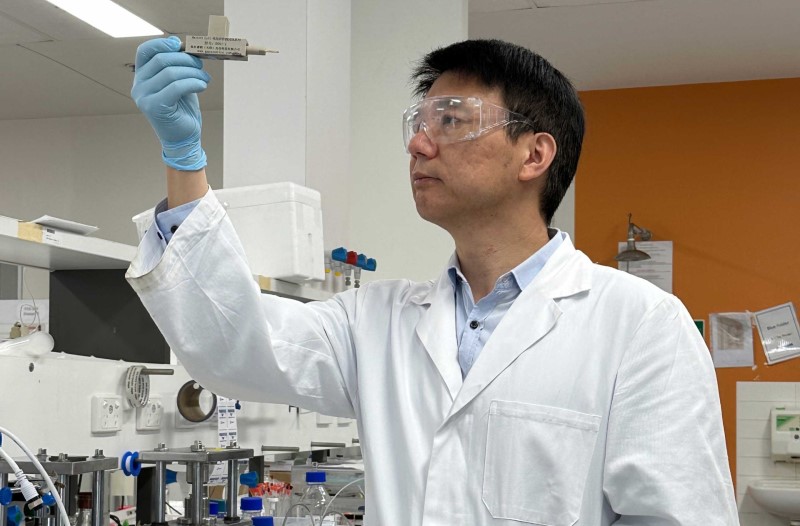
The team began with a small TABQ molecule containing four chlorine groups. After much experimentation, they replaced the chlorine groups with four amino groups. Their innovation significantly improved their high performance proton battery anode’s ability to store protons, and fine-tune its redox potential range.
“Proton transport is one of the most fundamental processes in nature, from the human body, to plants,” team leader Professor Chuan Zhao notes. “We can actually study how this type of organic molecule can be used, for a broad range of applications such as for hydrogen storage.”
More Information
Proton Exchange Technology Breakthrough
Hydrogen Fuel Cell Electric Car Update
Preview Image: Hydrogen Proton Exchange