Should we leave a lithium-ion battery in the trunk while traveling? That’s the space at the rear of a car the British call a ‘boot’. Airline companies generally don’t allow lithium-ion batteries in the hold beneath the floor. They ask us to keep them in the cabin, where we can keep our eye on them.
Risk of Leaving a Lithium-ion Battery in the Trunk
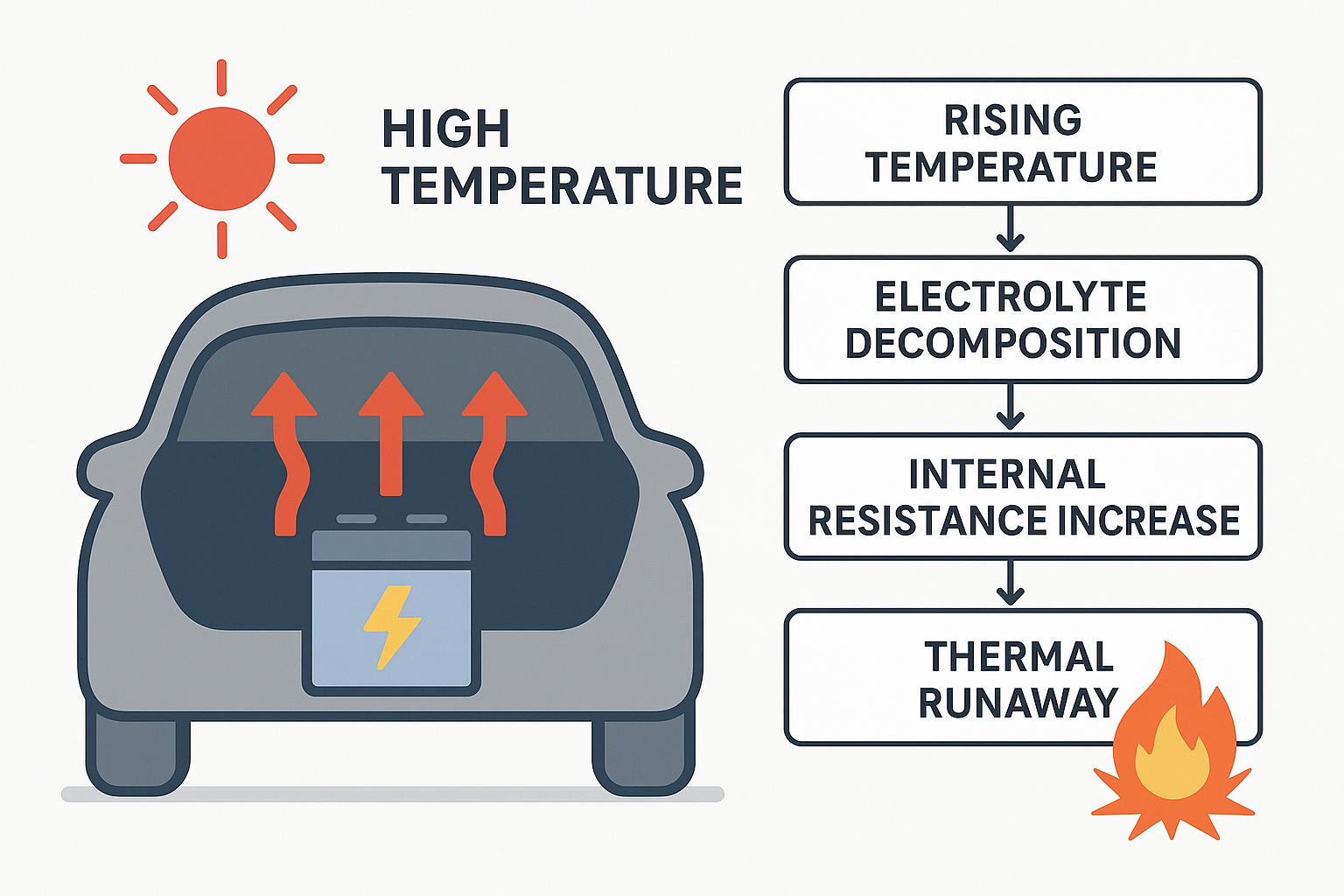
Ambient heat can accumulate inside a car trunk with the lid down, especially when left in a parking lot for several hours. The temperature could reach 60 °C / 140 °F in sunlight, and cannot escape. This is the tipping point where the heat could lead to a reaction inside a lithium-ion battery. However, this is unlikely to happen, if the battery is from a reputable supplier, and is undamaged.
But the lithium-ion battery could continue heating further, if it is defective, damaged, or charging from a power bank or a USB port. The internal battery temperature could continue rising if one of those conditions applies, and cause the electrolyte and separator to rapidly degrade.
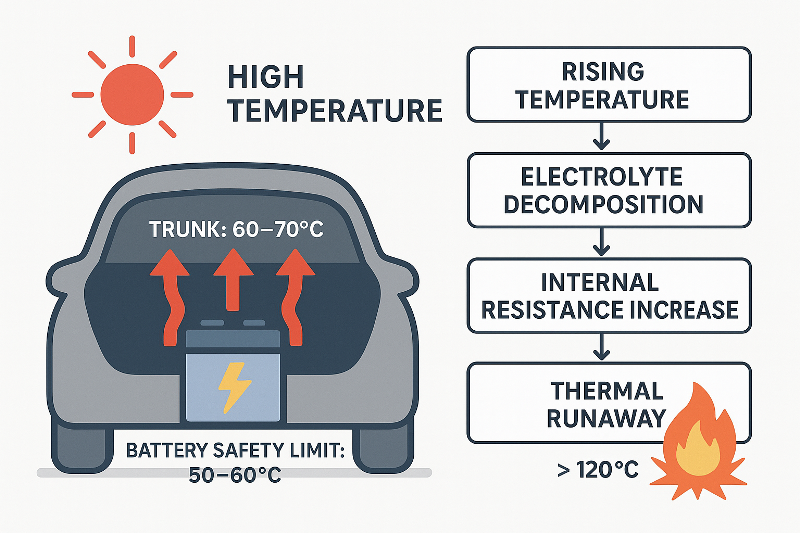
This degradation could open the door to the possibility of the battery electrodes touching. They could short-circuit between each other, and release all their energy in an instant generating considerable heat. This is likely to start an exothermic self-heating cycle.
The lithium-ion battery in the trunk will start producing flammable gas, increasing the pressure inside the battery. The cell may crack open and release this flammable gas. Or the battery could explode, and start an extremely hot fire in the trunk perhaps above the fuel tank.
Ideally, we should never leave a lithium-ion battery in the trunk. The safe upper limit is around 60 °C / 140 °F for storage, and around 45 °C / 115 °F for recharging. In theory, thermal runaway is only possible above 120 °C / 250 °F.
However, this runaway can occur at a lower rate if the lithium-ion battery is substandard, undergoing charging, damaged, or defective at the time. Purchasing a lithium-ion battery from an unverifiable supplier, is taking a chance we should all avoid.
More Information