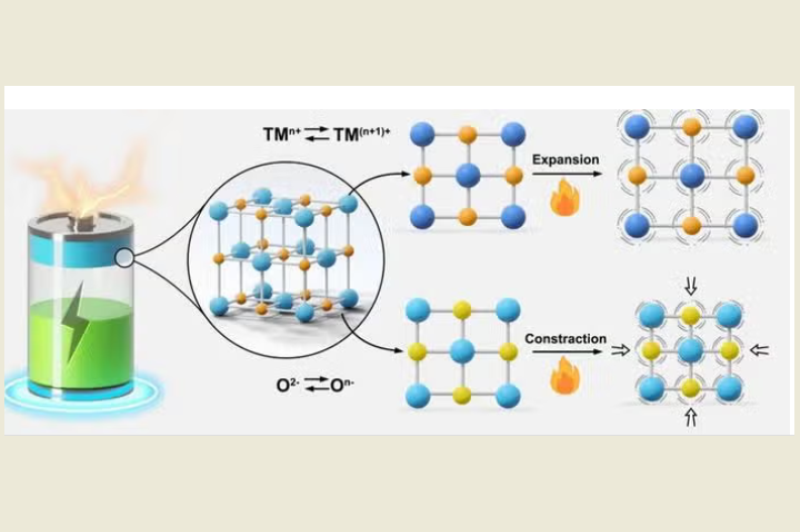
Materials expand as they become warmer, and contract as they cool down as a general rule of thumb. Their expansion is due to their molecules vibrating more vigorously and occupying more space, and vice-versa. Increased heat and vibration strains the material, and can damage it. Researchers at Ningbo Institute of Materials Technology and Engineering (NIMTE) in China, have identified materials that cause negative thermal expansion in batteries.
Negative Thermal Expansion Protects Lithium-Ion Batteries
The NIMTE media press release, that we link to below, looks forward to advanced battery technology with high energy density and durability. That’s not proven in practice yet, but we do need higher density lithium-ion batteries for our electric vehicles and aircraft.
Battery cathodes store electrical charges as ions, and release these to their anodes as batteries do their work. Recharging a battery restores those ions from the anode back to the cathode. The efficiency of a cathode thus has a significant bearing, on a battery’s energy density and cycle life.
Layered oxide cathode materials that are lithium-rich, beat commercial alternatives with over 300 milleamp hours per gram. This achievement can lead to 30% greater energy storage density, and without a cost penalty either. However, there is a catch, as there often is in our world of batteries.
Resolving This Problem With Batteries That Contract When Warm
The researchers at NIMTE knew that rich-layered oxide cathode materials, and their voltage, decay after repeated recharging. This is in part due to heat causing the materials to expand and degrade. The researchers investigated alternative materials, causing neutral or negative thermal expansion in batteries.
The NIMTE team used a robust predictive framework, to design the world’s first zero thermal expansion cathode. They believe this invention could address issues such as shortened battery life. The researchers hope thereby to advance next-gen, high-energy-density lithium batteries.
“The implications of these findings extend beyond the field of battery research,” a team member observes. Our work is original, interesting and important for offering new principles for designing functional materials.”
More Information
Battery Thermal Safety Layer Cools Runaway
How The LG Chem Thermal Blocker Works
Preview Image: Negative and Positive Expansion
NIMTE Media Release Announcing Discovery