We have comfortably assumed, until now, that droplets infected people breathe out fall to the ground within three to six feet. And hence it’s perfectly safe to share confined space together, as long as we distance and take safe precautions. However, a WHO brief just came to our attention that casts new light on airborne transmission in enclosed settings.
Droplet Sizes and Airborne Transmission in Enclosed Settings
A February 2020 study of 75,465 COVID-19 cases in China by WHO did not identify a single airborne transmission. However, it now seems droplet nuclei behave differently in still air. The report by the World Health Organization defines two different scenarios:
1… Respiratory droplets greater than 5-10 μm in diameter
2… Droplet nuclei smaller than 5-10 μm in diameter
Respiratory droplet transmission occurs when an infected person coughs or sneezes them out. AND they enter the mouth, nose, or eyes of another person. Secondary transmission can ALSO occur after the droplets land on a touchable surface.
However, droplet nuclei can REMAIN in the air for much longer. They can POTENTIALLY transmit infection to a person a hitherto ‘safe distance’ away. This is the basis for the World Health Organization’s alert regarding airborne transmission in enclosed settings.
Consequences of This Alert for Health Care Professionals
Health care professionals have always been at risk when applying chest respiratory treatments, and breathing assistance. The WHO emphasizes the need to take especially rigorous care under these circumstances. This is particularly vital when removing protective clothing, gloves, and masks, and washing hands.
It seems wise to take note of the possibility of airborne transmission of droplet nuclei in enclosed settings where the air is still. We don’t want to spread alarm. We just hoped to increase your awareness of the WHO report.
Related
Covid-19 Transmission in Meat Packing Plants
Linking COVID-19 and Gastro Infections
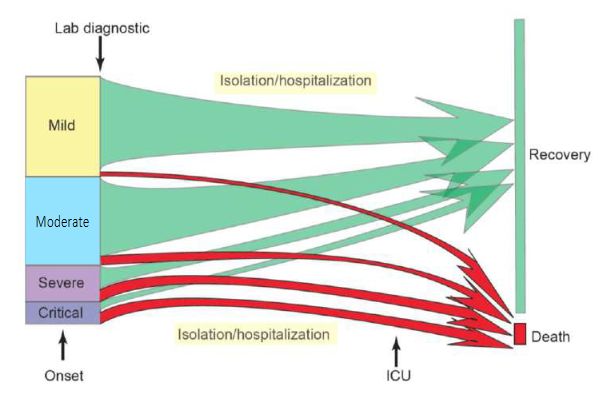
Preview Image: Disease Progression for COVID-19 in China