

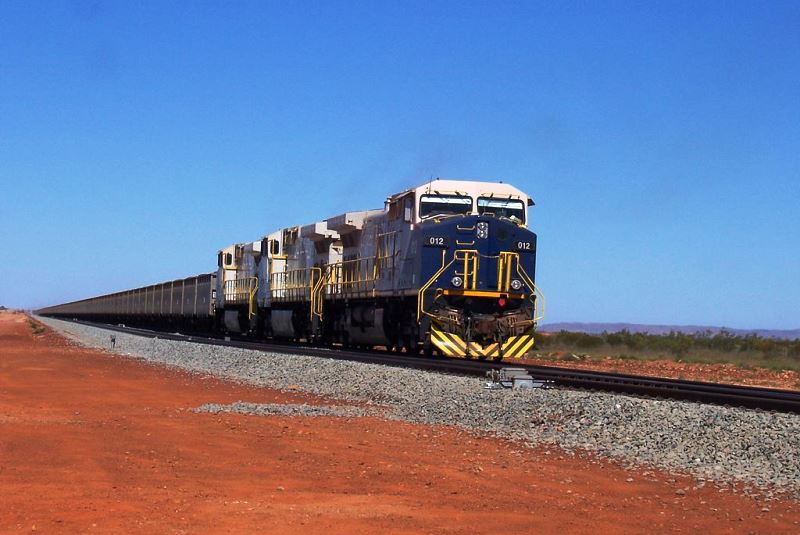
Australia’s wide open spaces, with large distances between towns make it a natural for renewable transport that keeps going indefinitely. There’s been talk of harvesting gravity for this purpose, but nothing substantive happened. Now an Australian ore-mining company has a vision of an infinity train that could recharge itself, and it seems feasible.
How the Gravity Inspired Train Would Work
Fortescue Metals is a global leader in the iron ore industry. It is the fourth-largest iron-ore producer in the world, with over 11,000 employees servicing seven major sites. Getting the ore to Australian ports to load on its seven ore carriers is expensive. So managing energy cost must be one of its top priorities.
Fortescue’s vision for an infinity train that could recharge itself is visionary but quite simple. ‘There is a lot of energy behind a train traveling downhill with 34,000 tons of iron ore’ they explain. ‘So why not capture all that energy with regenerative braking, and use it to power the uphill journey’ they ask.
The cycle would begin with a set of fully charged batteries. These would power the train up the first slope, and then receive a gravity top-up as it travelled down the other side. Their battery train has potential to become an ‘infinity train’ if this works. It could be a dream for the circular economy if comes true.
Resources for an Infinity Train That Could Recharge Itself
Fortescue Metals recently acquired ownership of UK-based Williams Advanced Engineering. Williams provides a technology / engineering service to meet challenges of 21st Century mobility.
Meanwhile Fortescue is no stranger to the freight rail business. That’s because it owns 54 conventional locomotives hauling 16 train sets an average 1.75 miles long. Their infinity train shows early signs of being a potential winner, with all those resources behind it.
Breaking News
New Flow Battery with Organic Polymers


1 Comment
Won’t work — this is basic physics. Regenerative braking will extract some energy, slowing the train down. The amount you extract will be less than the amount of energy available. This means that due to friction and other losses, you won’t have recovered enough energy to go back up the hill again. Perpetual motion machines can’t work.