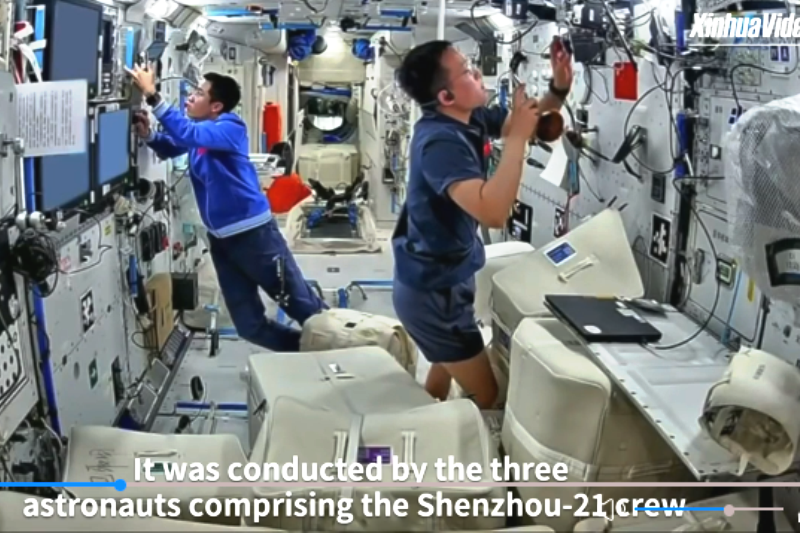
China’s space station named Tiāngōng, translates into English as ‘Heavenly Palace’. China Daily reports how Chinese astronauts up there, have just completed a battery test. Dalian Institute of Chemical Physics describes how this battery experiment in the Heavenly Palace, studied the impact of micro-gravity on internal performance of lithium-ion batteries.
Novel Experiment In Fundamental Battery Science
We had to delve into dictionaries to discover micro-gravity is a state where gravity is far less than on Earth. And this creates a situation of weightlessness in turn.
The astronauts wanted to know how this micro-gravity affected key processes inside lithium batteries. They hoped to learn how to improve the efficiency of these systems, when they are deployed on spacecraft.
This is particularly important where the technology is used in space, because of lithium’s relative lightness per energy stored. But we still lacked more information about how chemical distribution affects battery power and operating life.
The battery experiment in the Heavenly Palace hoped to isolate gravity’s specific influence on internal battery processes. You see, back here on Earth, this force tends to merge with the forces of the electrical field, and this smudges the effect.
What the Experiment in Heavenly Palace Revealed
The experimental model hoped to quantify the impact of gravity on lithium-ion batteries on Earth, by reducing it in space and observing the result. Ion transport, ion insertion, and ion extraction from electrodes were all of particular interest.
However, there was also a risk factor involved, because the liquid electrolyte could behave differently in micro-gravity in terms of stability. Fortunately, this did not prove to be the case.
Nothing untoward happened in that particular regard, during the battery experiment in the Heavenly Palace. The astronauts were free to capture detailed images of dendrite formation in real time.
The results offer much food for thought, in terms of the impact of gravity on lithium-ion batteries on Earth. We hope this work contributes to better, safer lithium-ion batteries for all of us in future.
More Information
Electron Sponge Mops Up Dendrites in Zn-Ion
Watching Dendrites Grow in Real Time