Lithium-ion electric vehicle battery impedance may naturally vary as the equipment ages, and its efficiency deteriorates. However, this resistance to electrical flow should remain within safe limits. But if something moves the impedance beyond safe tolerances, then EV vehicle battery stability is threatened. We report on a new technique to help identify this risk.
Current Technique for Assessing EV Vehicle Battery Stability
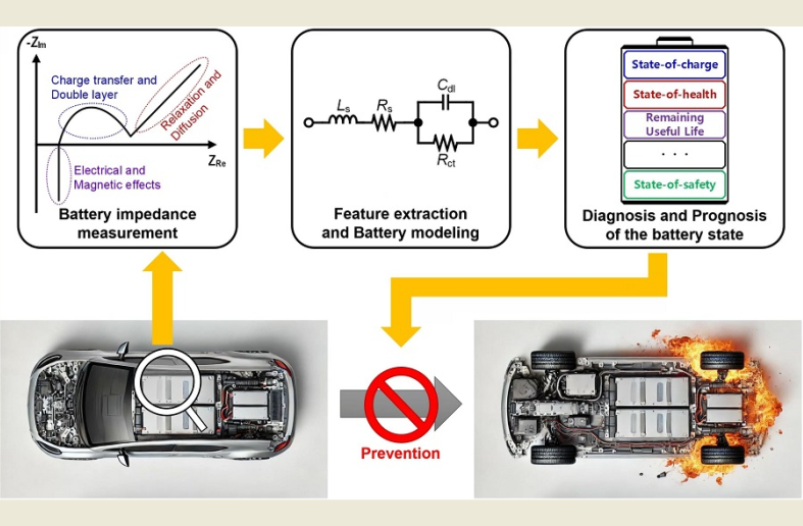
This resistance may be assessed by applying an AC potential to a battery, and then measuring the current through the cell. Scientists at South Korean Advanced Institute of Science and Technology (KAIST), have developed a new way to do so using electrochemical impedance spectroscopy (EIS).
EIS is a powerful tool for monitoring battery resistance, and the overall condition of batteries. That’s because the state of charge, and the state of health, are both critical factors influencing EV vehicle battery stability.
However, traditional equipment for measuring thermal characteristics and chemical/physical changes – and predicting battery life – is complex and expensive, according to KAIST. Moreover, the current testing method can stress the battery, increasing the chance of failure and fire.
These factors may have prevented using electrochemical impedance spectroscopy routinely to monitor electric vehicle batteries in normal use. The team from South Korean Advanced Institute of Science and Technology decided to do something about this.
The Advanced Institute of Science and Technology Solution
The South Korean team developed, and validated, a low-current EIS system for diagnosing the condition and health of high-capacity EV batteries. Their new technology allows them to precisely measure internal resistance with ultra-low currents.
This new system has several advantages over the traditional method for assessing EV vehicle battery stability:
- Testing at such a low current minimizes the thermal impact and safety consequences.
- The new, less costly equipment is less bulky, and therefore easier to incorporate.
“This system can be easily integrated into the battery management system of electric vehicles,” Professor Kyeongha Kwonthe explains. “It can contribute to battery diagnosis and performance improvements, not only for electric vehicles but also for energy storage systems.”
More Information
Magnetic Resonance Spectroscopy & Batteries
Reducing Resistance in Solid State Batteries