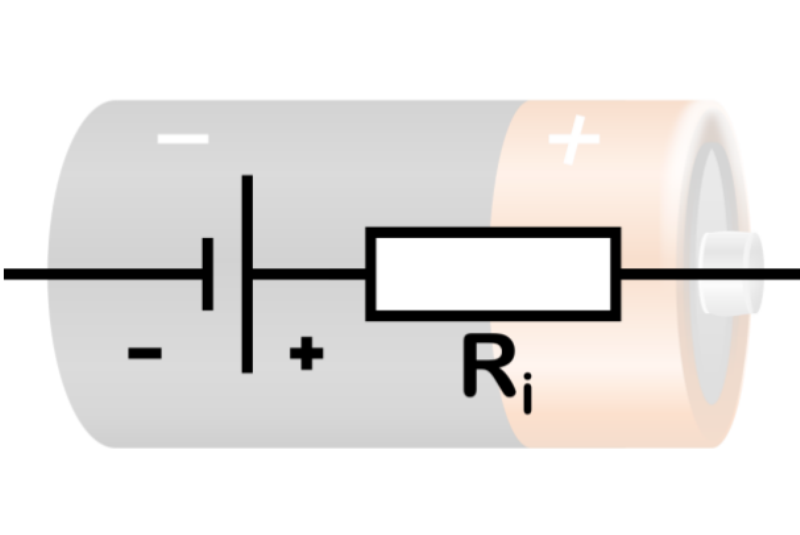
Why does a battery sometimes hold a good charge, yet does not seem to be working properly? Perhaps it is struggling to DELIVER the electricity our device needs to work properly. We discuss battery internal resistance in practice, and the contribution of the external circuit.
Internal Resistance in Batteries
There’s internal resistance in every electrical circuit, but the extent depends on the materials through which the current flows. The composition of the electrolyte, electrodes, and even the battery connectors all affect battery internal resistance in practice.
If we turn on a garden tap and squeeze the plastic hosepipe, the water flows more slowly. Resistance in a circuit does something similar by reducing effective battery voltage. If the connected load is too great, then that voltage may fall below the point the device can operate.
A number of factors affect battery resistance. These include the materials inside the battery, and the external temperature outside. Different battery types (alkaline, lithium-ion, lead-acid, etc,) all have different resistances. These can increase as a battery ages, and / or the battery becomes almost flat.
The effect of battery aging is what frustrates battery users most. Many consumers simply do not understand that their device’s performance deteriorates, because the current is struggling to get through. No battery can last forever. There comes a time when we must replace them with the correct replacement.
Practical Implications For Electric Car Batteries
Battery internal resistance boils down to two factors causing it in practice. Those factors are (a) resistance to electrons flowing through the external circuit, and (b) resistance to ions flowing through the internal electrolyte.
A low external temperature can cool a battery, increasing internal resistance. This finds expression in shorter electric car driving ranges. We can mitigate this effect by artificially warming the battery, but this does not address the root cause.
Much of the research that we report in our blog, probes different ways to reduce battery internal resistance. But there are limits to what we can do, with our current knowledge and the range of battery chemistries on the table today.
More Information
Battery Internal Resistance and Performance