There’s a race on the go to recover nodules of rare metals from the ocean floor, before science has fully assessed the environmental impact. The Clarion-Clipperton zone in the Mid-Pacific is one such target, because of abundant reserves of manganese modules. Some scientists warn we should not overlook the dangers of deep sea mining, in our scramble for battery materials.
Could Deep Sea Mining Tamper With The Origins of Life?
We’ll stay away from mentioning names directly, because there is deep controversy over what follows. Suffice to say, we understand that a deep-sea mining company commissioned an environmental study. And then rejected the findings as “plagued by methodological flaws” according to Geo News.
We append a link to the Geo News Article, and the original research report below. The latter document begins with these words:
“Deep-seafloor organisms consume oxygen, which can be measured by in-situ benthic chamber experiments. Here we report such experiments at the polymetallic nodule-covered abyssal seafloor in the Pacific Ocean.
“Experiments in which oxygen increased over two days to more than three times the background concentration, which from ex situ incubations we attribute to the polymetallic nodules.
Given high voltage potentials … we hypothesize that seawater electrolysis may contribute to this dark oxygen production.”
This hypothetical origin of ‘dark’ ocean oxygen flies in the face of an assumption that life on earth began when organisms started photosynthesizing sunlight into chemical energy and oxygen. The researchers’ concerns over the dangers of deep sea mining, center on the question should we tamper with the origins of life in the ocean?
At Least Two Opinions Regarding This Finding
We deliberately choose not to take sides on the finding, and hypothetical conclusions of the research. We merely convey this information for what it is worth, because we need to be aware of the environmental impacts of deep sea battery material mining.
However, we do add that the presence of dark oxygen shows just how little we know about life at these extreme depths. And this supports the case that deep-sea mining should not pose unacceptable ecological risks.
More Information
Deep Sea Mining Authority Drags Its Feet
Deep-Sea Battery Mineral Mining a Step Closer
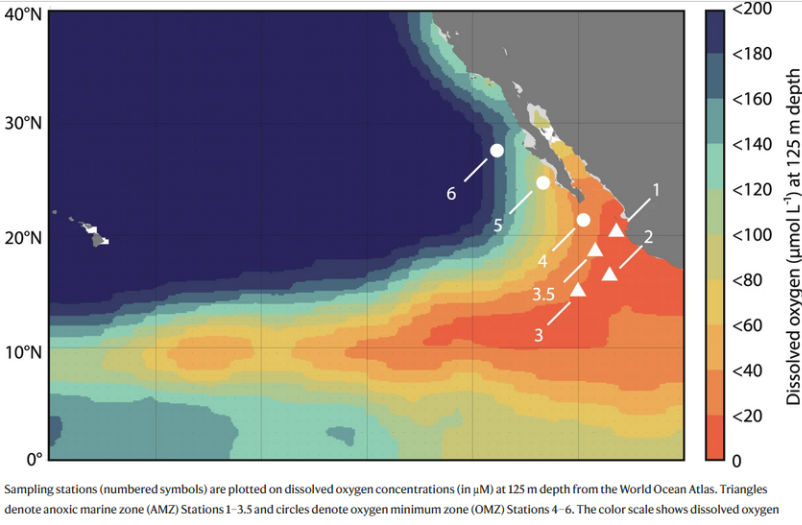
Preview Image: Dissolved Oxygen Concentrations