The Fraunhofer Centre for High Temperature Materials and Design is in Bayreuth, Germany near the Swiss border. The main thrust of its research involves high temperature technologies and energy-efficient heating processes to support sustainable technological progress. It has made remarkable strides with a dry transfer coating for battery electrodes.
A Dry Transfer Coating Method for Environmentally Friendly Batteries
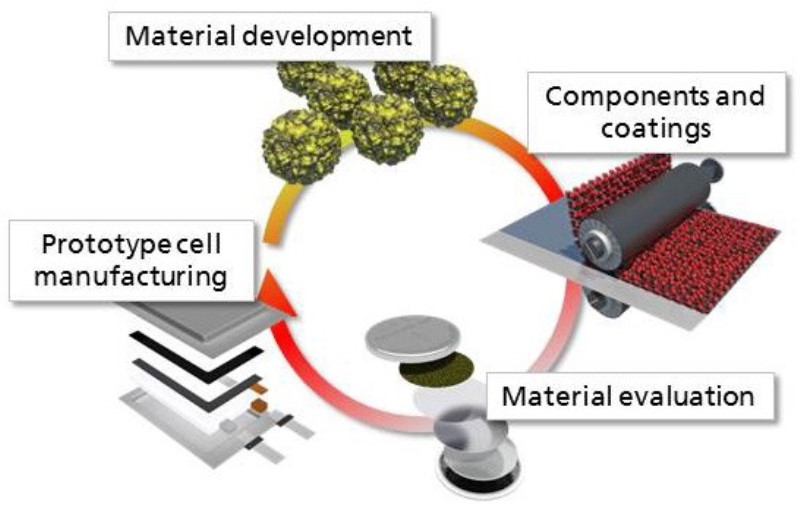
Fraunhofer researchers have developed a process to coat electrodes in energy storage cells with dry film, instead of liquid chemicals. They say “this simplified process saves energy and eliminates toxic solvents”. Moreover, a Finnish company is successfully testing their technology in practical trials.
Battery production in Germany is expensive, because of high energy costs compared to Asia. The Fraunhofer Centre hopes their dry transfer coating will significantly decrease these expenses. “Manufacturers can eliminate toxic and expensive solvents and save energy costs during drying,” they say. “In addition, our technology also facilitates the use of electrode materials that are difficult or even impossible to process wet-chemically.”
The Advantages of Dry versus Wet Electrode Coating
Lithium battery cell makers generally use complex wet-chemical processes to coat their electrodes with active ingredients. First, they mix these ingredients with additives to create a paste. This involves adding expensive, usually toxic solvents requiring elaborate health and safety precautions.

Finally, they dry their coated films with large quantities of expensive electricity. However, the Fraunhofer dry transfer coating method involves mixing the active ingredient with a polymer. Then they spin the compound in a rolling mill where shear force creates ‘spider webs’ of electrode material. Finally, they laminate their 100 micrometer thick film onto aluminum foil to create a battery electrode.
It is as simple as that and apparently it works rather well. Moreover, the solvent-free process will also improve battery functionality in electric vehicles.
Related
Lithium Battery Advance for Sulfur Electrode
New Research: Electrodes Charge and Discharge Rate
Preview Image: New Fraunhofer Electrode Dry Coating Technology