Will lithium battery performance be any better in practice, now that Ulsan scientists have found a way do so in a laboratory? We wish we could be more optimistic about this. It’s just that commercializing theory takes a long time, and the will is seldom there to spend the money.
Will Lithium Battery Performance Improve if We Coat Lithium Foil?
That has been the question on scientists’ minds at the Ulsan National Institute of Science and Technology. They wondered if this would significantly improve lithium metal batteries’ performance for next-gen electric cars.
They may have finally made their breakthrough, at least in theory, the Phys Org service announced on September 18, 2018. This was when they followed through on previous work to eliminate dendritic deterioration in lithium-metal batteries. Rechargeable lithium-metal cathodes have ten times more capacity than conventional graphite anodes. They also have the lowest driving voltage and hence appear an ideal solution except for one thing.
The One Thing Lithium-Metal Fears Most: Dendrites
While lithium-metal batteries seem ideal for electric vehicles and energy storage, dendrites have tended to hold them back. Lithium metal puts out ‘tentacles’ during the charging-recharging cycle. Scientists have wondered will lithium battery performance ever surmount this problem.
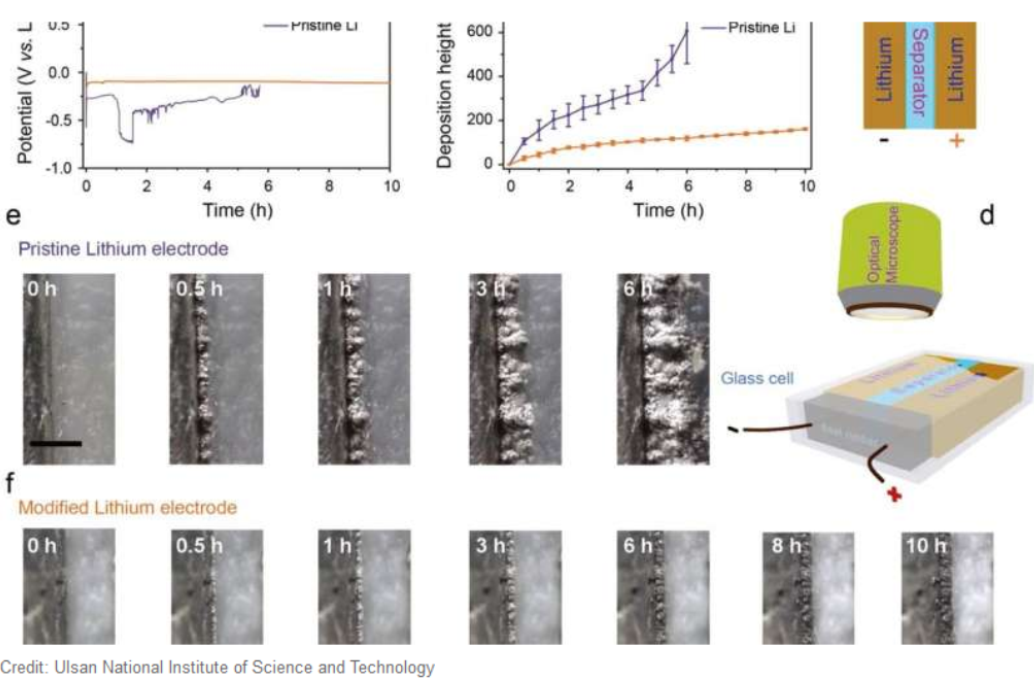
The problem lithium batteries face is they short-circuit when the dendrites tentacles penetrate the battery separator keeping the electrodes apart. The team at the Ulsan National Institute of Science and Technology has discovered how to suppress them. And their solution is as elegant as coating the lithium foil with a lithium silicide LixSi layer.
An in-situ optical microscopic observation reveals “a much more uniform lithium dissolution/deposition on the LixSi-modified lithium anode. When compared to the bare lithium electrode,” the Ulsan National Institute of Science and Technology reports.
Related
Cryo-Electron Microscopy Spies on Dendrites
IUPUI Researchers Stop Dendrites Spreading
Preview Image: Novel Way of Improving Battery Performance
Ulsan National Institute of Science and Technology Research Report