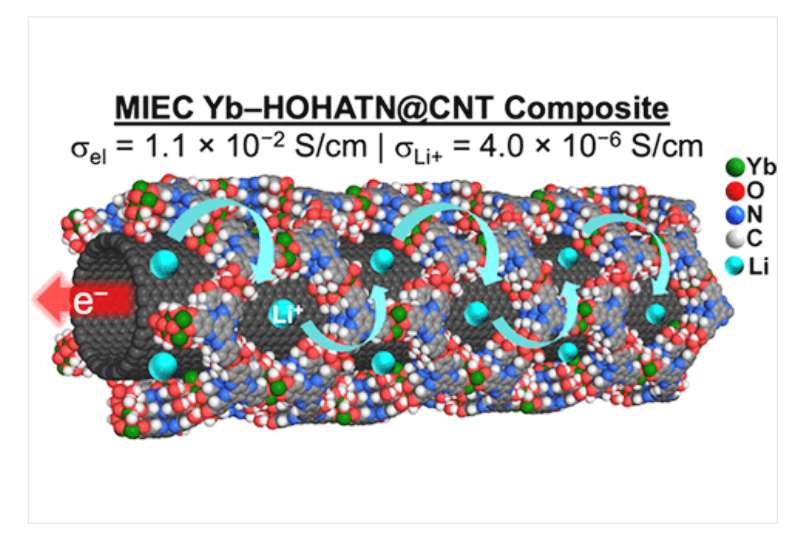
Almost all charge-conducting battery materials can transport either lithium ions or electrons, but not both. Clemson University scientists in South Carolina, announced their discovery of a dual conductive battery material on February 16, 2026.
Their discovery allows the same material to transport lithium ions and electrons at the same time. We investigate what the purpose of this is, and how it could benefit battery users in due course.
Exploring The Dual Conductive Material
The new dual conductive battery material combines lithium-ion-conducting metal-organic frameworks, with electrically-conductive multi-walled carbon nanotubes. So what’s the deal?
The deal is this new approach allows the material to simultaneously transport lithium ions and electrons at the same time. “We hope this material will prove suitable for lithium-ion battery electrodes,” a team member explains.
Almost all electric vehicles and portable devices currently use lithium-ion batteries. This means they have microscopically-small lithium ions (atoms) shuttling between their electrodes.
Meanwhile, electric charges come and go via their battery terminals. Different parts of these batteries perform different roles. We imagine there could be a size and cost saving from using dual conductive battery materials.
Delving Deeper Into Battery Metal Organic Frameworks
What follows takes us into the realms of deep science, in particular relatively-new metal organic frameworks. These are a fairly new class of porous metal-ligand (ion or molecule) coordination polymers.
These compounds – and here’s the point – have a rare potential to transport both ions and electrons simultaneously. But somebody needs to ‘push the right buttons’ in a laboratory to realize that potential.
The team of scientists at Clemson University did just that. They teamed lithium-ion-conducting metal organic frameworks (MOF) with electrically conductive multi-walled carbon nanotubes.
“This composite design gives us the best of both worlds,” their spokesperson explains. “The MOF offers excellent ion transport, and the carbon nanotubes ensure that electrons can move rapidly. Usually, you get one or the other. Ours does both.”
More Information
How Ions And Electrons Work Together
Electrons Versus Ions in Batteries
Preview Image: The New Composite Material