The ‘Indian Lilac’ Neem tree, is a glorious profusion of pink flowers in season. These produce large quantities of seeds that fall to the ground, and mostly decay. Scientists at Hanyang University in South Korea have converted these seeds from flowers to thermal energy storage material. In this way the processed seeds capture, store, and release heat in a green energy loop.
Creating Thermal Storage From Flower Seeds
Storing electrical energy from heat is a viable alternative to conventional batteries. The search is on for suitable environmentally-friendly natural materials. The South Korean researchers may have known that traditional uses for Neem seeds include cooking spices and natural medicines.
However, this time they decided to try something different. They found a way to transform Neem seeds into an effective thermal energy storage material, that proved environmentally friendly too. Along the way they discovered that the temperature they applied affected the storage ability of their material.
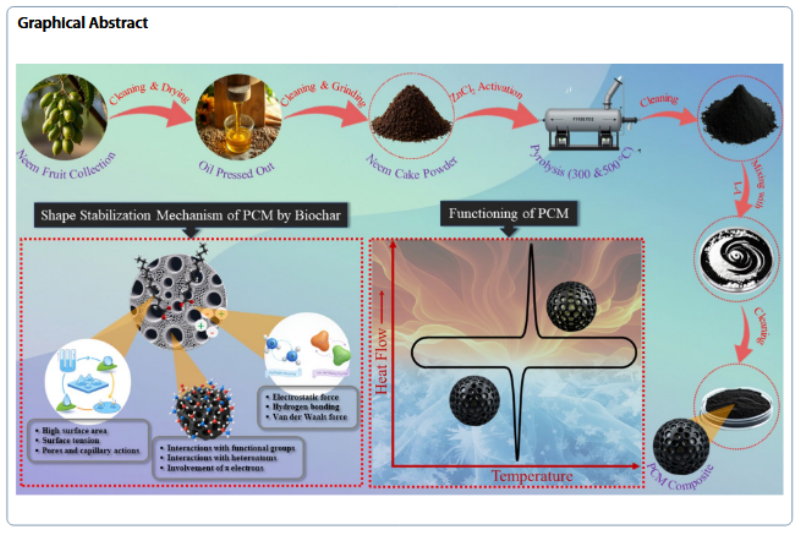
The scientists changed the seeds from the flowers to thermal energy storage material. by heating them. In this instance they used two temperatures: 300º and 500º celsius (570º and 930º fahrenheit) to convert the material to porous carbon. Then they added lauric acid as a catalyst.
The result was a material that melted as it absorbed heat, but then returned to a solid state as it gave up the heat. The researchers had achieved their goal. They had successfully produced an effective thermal energy storage material, that was environmentally friendly too!
How Processing Temperature Affected Storage Capacity
Applying heat to the seeds produced a stable, carbon-rich ‘biochar’ material. Using the higher 500º celsius heat (930º fahrenheit) delivered a ‘spongy’ product with multiple pores for storing the lauric acid catalyst.
This higher temperature enabled the biochar material to store twice as much heat compared to the lower-temperature option, without leaking the catalyst. This degree of stability makes this discovery a candidate for real-world energy storage applications.
More Information
Nanoporous Carbon With Very Large Surface
Thermal Batteries And Energy Storage Today
Preview Image: Neem Seed Biochar Features