Would you like to know how sodium-ion batteries work? Well, sodium-ion batteries look very much like lithium-ion batteries at first glance, but there are differences inside their cases.
If You Peered Inside a Sodium-Ion Battery You Should See …
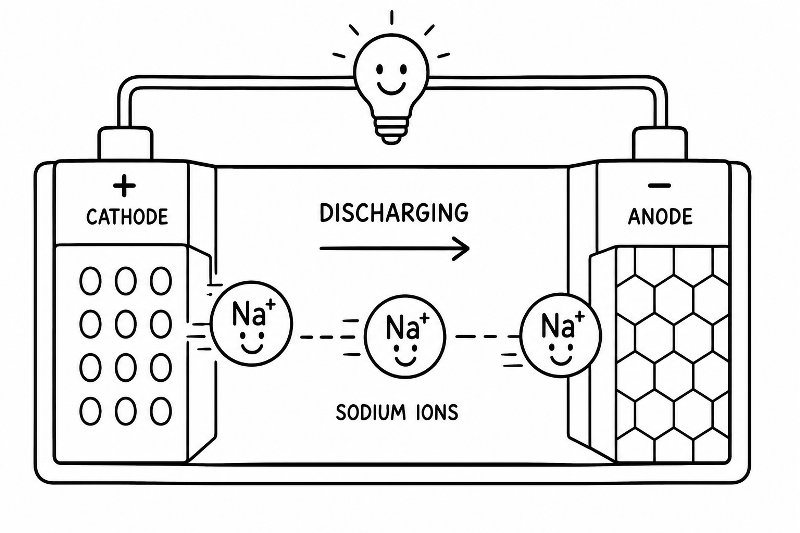
If you peered inside a sodium-ion battery you should see a positive electrode, a negative electrode, some electrolyte, and a separator. These components generate electricity by moving charged atoms, called ions between the two electrodes, but only if the battery is part of an external circuit.
How These Battery Parts Send Electricity Through a Circuit
When a sodium-ion battery charges, sodium ions move through the electrolyte and store in the negative electrode. During discharging they return to the positive electrode, while electrons travel through an external circuit to power a device.
If That Sounds Like a Lithium-Ion Battery You Are Correct!
Sodium-ion batteries work almost like lithium-ion batteries except for one major difference. Sodium ions are larger and heavier than lithium ions, making them more difficult to pack into the same space. For this reason, today’s sodium-ion batteries generally store less energy for their size and weight.
Researchers are making impressive progress to close this gap, by developing improved cathode materials, hard-carbon anodes, and more efficient electrolytes. These advances have increased battery life, charging speed, and narrowed the performance gap between sodium-ion and lithium-ion chemistries.
Sodium-Ion Batteries Also Work Well At Low Temperatures
Sodium-ion batteries also perform well at low temperatures, which is important for electric cars during cold winters. They also use materials that are widely available around the world. This makes them attractive for large energy storage systems and lower-cost electric vehicles.
Lead-acid batteries remain a proven choice for many backup power systems, while lithium-ion batteries continue to dominate portable electronics. Sodium-ion batteries are emerging as a third technology, that could fill an important role where cost, safety, and abundant materials are priorities.
Next Time We Will Expand The Horizon To Safety
Next time, we’ll examine why many experts believe sodium-ion batteries could offer important safety advantages in certain applications. While also understanding where lithium-ion batteries continue to excel.
More Information From Our Blog