Immersion cooling for big batteries in battery energy storage systems (BESS), has drifted in and out of the headlines. This definitely is a worthwhile option to consider though, given the number of recent BESS fires. Researchers at Ulsan National Institute of Science and Technology in Republic of Korea, recently investigated the option (see link below)
Immersion Cooling Spent EV Batteries for BESS
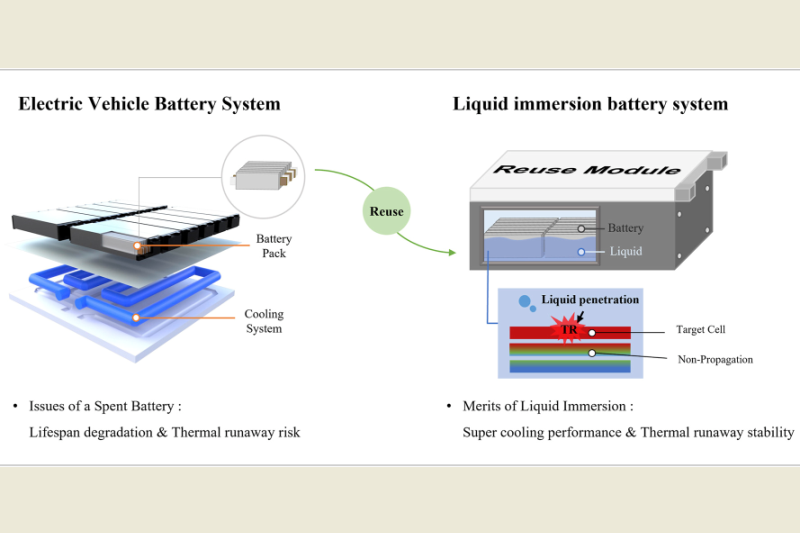
A huge stockpile of spent electric vehicle (EV) batteries is on the horizon, without a coordinated effort to reuse them. The Ulsan National Institute team investigated the fire hazard from stacking large numbers of these lithium-ion batteries in BESS systems.
This is a most important matter, given the increasing contribution that renewable energy makes to electricity supply. Repurposing used EV batteries should reduce the capital cost, provided they have support from dependable thermal management systems.
For if these systems are lacking, then a faulty repurposed EV lithium-ion battery could overheat uncontrollably. It could begin to burn and even explode, endangering the rest of the battery storage system.
The Ulsan National Institute team researched immersion cooling for big batteries in BESS systems, using pouch cells. They found that water immersion “exhibited fire prevention capabilities during emergencies”.
It also delivered “superior thermal management performance during regular operations, owing to the high thermal conductivity and specific heat of water”. This makes it an attractive option, compared to dielectric fluids.
XYZ Battery Company Showcases Commercial Version
XYZ Battery Company in Beijing, China ranks amongthe nation’s top ten BESS providers for commercial and personal use. Their comprehensive energy storage monitoring system already provides a workable solution.
However, we were particularly interested to discover that XYZ Battery Company has developed a battery immersion cooling system. This submerges battery cells in a ‘specialized thermal fluid’ for enhanced heat dissipation.
PV Magazine confirms that XYZ Battery Company launched this new product at the May 2025 Intersolar Europe Trade Show. We understand that the dielectric fluid it chose can store an electrical charge, but has poor electrical conductivity.
More Information
Lead-Acid Energy Storage Research
Pollution From Big Battery Fires Detected
Preview Image: Battery Immersion Cooling in Action
Report by Ulsan National Institute of Science and Technology