We are proud to manufacture, and sell lead-acid batteries throughout North America. Our product has a history of storing and delivering electricity that began in 1859. Your lead-acid battery quality comes with an assurance the electrolyte should not catch fire because it is mostly water. Our products are also affordable compared to other types of batteries with similar voltages, and that’s good for your cash flow too.
Quality Lead-Acid Batteries Use Simple Technology
Some 164 years of development have evolved our lead-acid batteries into one of the simplest designs in the battery industry. Brainy Quotes reminds us of Steve Jobs, who once remarked, “Simple can be harder than complex. You have to work hard to get your thinking clean to make it simple. But it’s worth it in the end.”
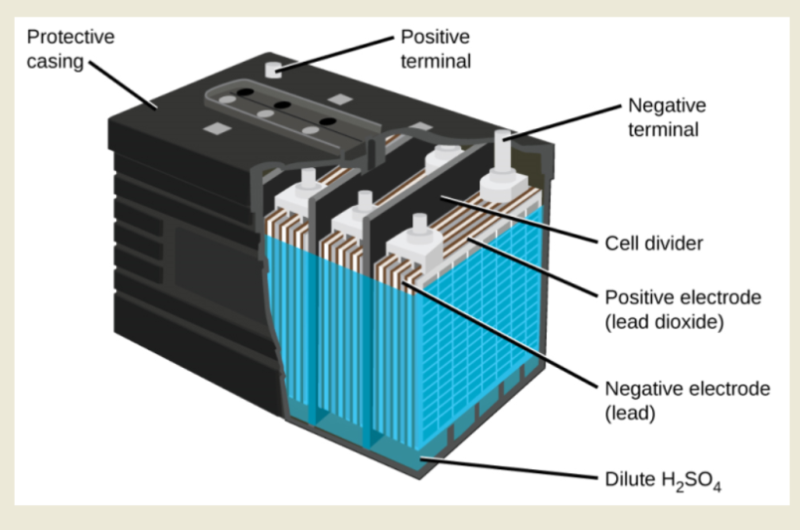
Lead-acid battery quality comes down to putting negative lead and positive lead-dioxide electrodes in a diluted sulfuric-acid solution. Reducing or increasing the number of cells, lowers or raises the voltage in measured step changes. Our cut-away diagram above shows the individual parts, and general appearance of a typical lead-acid battery.
There are three varieties of basic lead-acid batteries on the market. These are liquid-electrolyte starter batteries which require maintenance, and absorbent-glass-mat ones which are an improvement. But we only manufacture and sell the third type, deep-cycle gel-electrolyte ones, which offer enhanced performance, and longer battery life.
Battery Life May End, But the Story Continues
The simplicity of their design makes lead-acid batteries extremely easy to recycle, compared to lithium-ion. In fact, Science Direct assures us, “lead–acid batteries are one of the most recycled products throughout the world, with a recycle rate in most countries exceeding 95%”.
Uplifting spent lead-acid batteries is simple, because retail suppliers have exchange policies, and wholesale suppliers collect spent batteries while delivering new ones. We are reminded once again of Steve Jobs. Simple can be harder than complex. You have to work hard to get your thinking clean to make it simple. But it’s worth it in the end.
More Information
Lead-Acid Battery Assembly and Chemistry