The technology of li-ion batteries may be the best energy storage yet. Considered as today’s ultimate rechargeable battery, li-ion is lightweight, portable and can store a vast amount of energy which can be discharged and recharged for many cycles. Its affordability makes it a great source of power for consumer electronics. It is no wonder that li-ion is a common battery associated with most of today’s mobile gadgets.
However, the li-ion battery technology is not without limitations. Some of its constraints are:
- Lithium deposits in the graphite can cause cell rupture or explosion.
- Li-ion diffusion constraints can cause poor battery connectivity. This can be traced in micron-sized particles within the electrode.
- Binders used in electrodes will degrade over time.
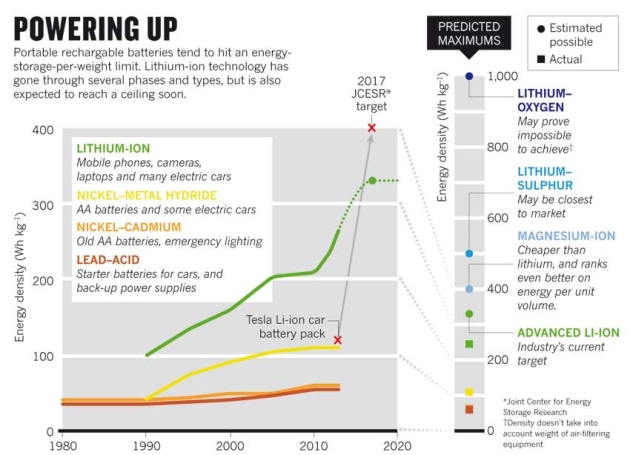
Researchers believe that the perfect energy storage is yet to come.
One approach to improving the current li-ion battery technology is a Nano-based electrochemical synthesis promoted by the Argonne National Library. Sanja Tepavcevic, member of the research team, has found a way to replace lithium in the li-ion technology with magnesium. The result is the Magnesium-ion (Mg-ion) battery.
Mg-ion promises to achieve greater energy density than the current li-ion technology. And because Magnesium is the 8th most abundant element in the Earth, this new product will be environmentally-friendly and affordable for consumers.
Comparing Lithium And Magnesium
| Theoretical Values | Li | Mg |
| Cation Valence | 1+ | 2+ |
| Atomic Weight | 6.94 | 24.3 |
| Specific Capacity (Ah/kg) | 1000*- 3862 | 2205 |
| Specific Charge Anode (Ah/l) | 2046 | 3833 |
| Electrode Potential (V) | −3.05 | −2.38 |
| Natural Abundance (%) | 0.006 | 1.94 |
The New Mg-ion Battery
The new cathode material for the Mg-ion technology will be composed of a nanostructure layer of non-crystalline material in order to control the polarization capability of Mg².
With the Mg-ion technology, it is possible to extend the chemistry of ions with a higher charge. Magnesium ions have a positive charge of two, which allows the battery to store more charge per gram. Also, common electrolytes can be used to reversibly intercalate Mg-ions in full cells.
While the new Mg-ion technology comes with its new set of challenges, it has paved the way to new discoveries and possibilities in finding a perfect energy storage.
Image Source: Nature.com
Related Posts:
New Lithium-ion Battery Design: 2,000 times more powerful, recharges 1,000 times faster
Scientists Develop Cross-Linked Electrolytes To Make Lithium-Ion Batteries Safer
Guidelines for Extending Your Lithium-Based Battery’s Life
Lithium Manganese Oxide Battery: Better Performance and Reliability